

Skateboarding: A Lost Art
Gallery
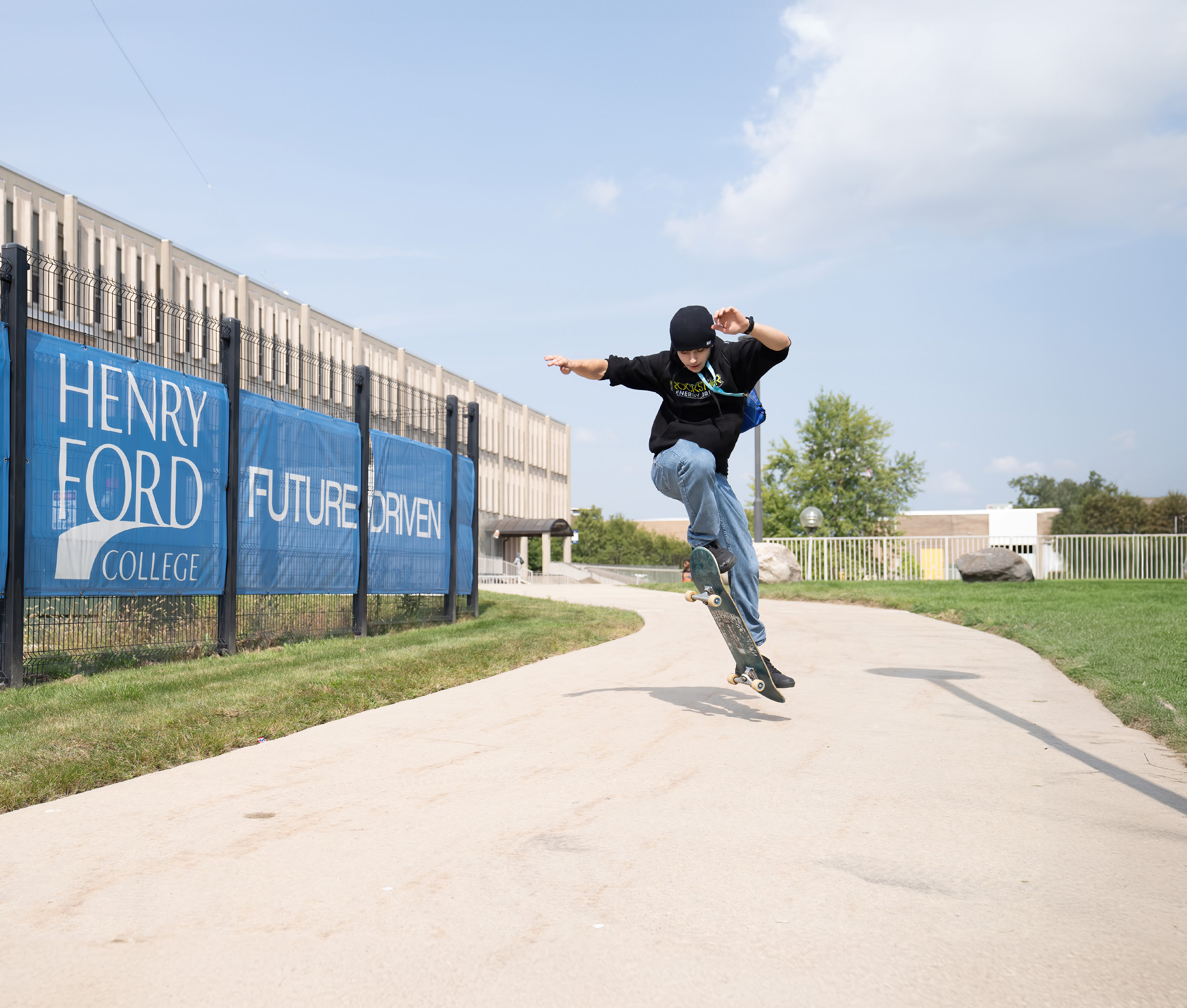
Mark Strong is currently a facilities associate at Henry Ford College, but that wasn’t always the case. After leaving the Skylight Café, Strong stumbled upon four students, Maryam Ardaini, Eman Fadel, Zayneb Ben Haj Mohemmed, and me. We sat with Fadel and Ardaini’s skateboards planted against our seats, and Strong asked to try out Maryam Ardaini’s custom-made board. Strong displayed tangible experience in his tricks and the energy and control he had over the board. This moment led to an impromptu interview outside Skylight Café.
“I have been a skateboarder for almost three years and have been working at Henry Ford College for 20 years,” Strong said.
The sport was so popular with the youth during his time that he and his family started a family business, Degenerate Skateboards, in 2009.
“It was a lot of fun,” Strong reminisces, “I got to meet up with a lot of pros and hook up with numerous other kids interested in the sport, and even earned sponsorships with shoe companies and things like that. A con I experienced was all my buddies would go out to skate, but I was stuck having to run the shop. But it was a blessing and a fun experience, but now it is on to new things, I suppose.”
Degenerate Skateboards operated for three years until Strong’s family was forced to sell. “There were only so many people,” Strong explains, “Skateboarding is what you would call a ‘niche subculture, ‘ so only so many people came to buy skateboards.”
Strong further explained that often people kept their skateboards for years. Regardless of the business’s undeniable growth, it required incredible work to maintain. Strong and his family didn’t want to invest time and capital even though it was a lot of fun. They had families and other endeavors that they wanted to pursue instead.
Thinking back, Strong believes, “Skateboarding was popular when we started, but I think it began slowly fading a little bit. During that time we saw Tony Hawk games coming out, and people were so excited about it. But it faded, and people now have their phones to focus on.”
During Strong’s time in the skateboard industry, he spearheaded the building of the popular Melvindale Skatepark. A company out of Maine called Who Skates? built the park. Strong began building the park in 2009 and reached out to Tony Hawk’s Skatepark Foundation. Strong earned a $5,000 grant from the foundation. “It was cool because we sent them our blueprint of the vision we had for the park, and Jamie Thomas, a pro skateboarder and member of the board of directors at Tony Hawk, scribbled out some parts of our blueprints and added what he deemed better and then sent it back,” Strong remembers. “That was super cool to have. To build the park, a lot of people came together, and there were a lot of great memories and fun times at the park, and I am glad to have been a part of that.”
According to Strong, “What I loved about skateboarding was there was always something to learn, and you could always go at your own pace, but no matter what, progression was possible.”
At 10 years old, Maryam Ardaini bought her first skateboard from Walmart in 2020. She’d been considering it for some time and finally bought a Tony Hawk model. Ardaini gave up on the sport until 2024, when she started high school and soon learned that her close friend, Eman Fadel, had a similar experience.
Fadel purchased a skateboard long ago but never picked up the sport due to lack of popularity, fear of failure, and scarce support and relatability. Ardaini and Fadel soon started bringing their skateboards to school and got their friends into it too. Since her freshman year, Ardaini has increased her confidence and knowledge of skateboarding. This past year, she invested in a new skateboard she built herself, adding a Spider-Man print grip tape, along with high-end wheels and trucks.
Ardaini says, “It’s actually so cool how many people I meet and the friends I make because I skate. I often felt like it was looked down upon, and I feel like it isn’t as common as other hobbies and sports. It’s so comforting knowing that whatever level you are in skating, there is always someone in the sport you can learn from.”
Ardaini adds, “When it comes to the sport, you’re never done when it comes to obtaining or sharpening your skills in skateboarding- there’s always something more out there for you to discover and learn.” Ardaini continues, “You can do different styles, personal tricks, skate on flat ground or ramps. There is no time limit when it comes to skateboarding.”
For Ardaini, “Skating has so much to do with style.” Ardaini explains, “Your style is sort of represented in how you skate and how you personalise your board.” Ardaini adds, “You pick each piece based on how it will help you perform and cater it to your liking.”
Ardaini’s close friend, skating partner, and HFC student, Eman Fadel said, “I bought my first skateboard when I was eight years old; it was actually a penny board which is a bit smaller than a skateboard.”
Richard Cremeans shared his experience with skateboarding. Cremeans, who is currently studying psychology with the intention of becoming a cardiology physician assistant, recalls, “I got into skateboarding as a pre-teen. I got a checkerboard grip tape on my first skateboard and my buddy, and I would ride around Melvindale. It eventually got stolen in church! (Of all places).” Cremeans got into skateboarding because “the guys in my neighborhood all decided to get boards.” Cremeans said, “I went up to Meijer and got a crappy one to ride around on and slapped that nice grip tape on it. After my board was stolen, it wasn’t until I was an adult that I got back into it. I put together a custom Blind board from Canada, trucks, bushings, grip tape, everything.”
Cremeans admits, “After my board got stolen, I’ve always felt a deep calling to return. Despite that longing, I started getting clean haircuts, wearing button-up polos, khakis, and even became part-time faculty teaching at WCCCD before I finally decided to get back into it. Something about me was drawn to and identified with that counterculture/rebellious spirit. Some part of me really wanted to wear Vans, listen to punk, and kickflip off a flight of stairs.”
Cremeans says, “Despite this idealization, growing up I had to contend with the rigid gate-keeping authority some of the older kids took on. They ran the skatepark and didn’t let anyone else in. You had to prove yourself to get access, and I never quite got there. This was a toxic part of the culture that sought to covet and close it off from newbies and, ironically, become the thing skating was against! I liked the camaraderie, building friendships, and skating with others together. Teaching each other new tricks is always a good feeling. I ended up tearing my ACL skating and gave my Blind board up to my friend on-campus Joseph.”
Cremeans observes, “It seems like skating has died down a lot and people just aren’t out there kickflipping off of staircases and tearing their ACLs anymore, which is a shame! It must be these phones everyone’s faces are glued to. That’s my thought anyway. I’m not sure where the future of Skating is. Maybe in 10 years we’ll have outsourced our rebellious-punk instincts to AI robots too. I wished the collective would realize the hooks technology has in us and just go outside again, maybe something really cool like fall down but get back up and do it again. That might be the essence of skating.”
Abdulqader Abdulaziz, popularly known as “Bood,” is a fitness enthusiast and social worker with a BA from Eastern University of Michigan. Bood was incredibly talented and involved in skateboarding back when Degenerate Skateboards was still running, and the skatepark was freshly constructed. Like Maryam Ardaini, Bood initially bought his first skateboard, a simple Tony Hawk, from Walmart. But that was just the beginning.
Bood says, “I started off with a very cheap skateboard from Walmart just to see if I could ride it. I eventually got my first real board from Degenerate Skateboards, which is now closed. I got into it because I would see people skating around at that time, and cool kids in movies and TV were all skaters. I was the first in my family to start skating, and they eventually all picked up the sport as well. I had friends in elementary school and middle school who skated. We would hang out after school at the skate park.”
For Bood, “I feel like skating died out in 2012. I’m not sure why exactly, but everyone kind of just stopped at the same time. The only people that still skated were the ones who were very talented. I enjoyed my time skateboarding, and I think it would be a great experience for kids to experience it now. Now I see kids on e-bikes and motorbikes.”
Bood adds, “My favorite part was definitely when you learned a new skill. It takes a lot of practice, falling, and scraping, but when you finally hit a move you’ve tried hundreds of times, you feel a huge sense of accomplishment. It also sharpened your balance, coordination, and athleticism. It taught you to keep trying and fixing your mistakes, and that builds a lot of character that goes further than skateboarding.”
Bood’s enthusiasm for skateboarding didn’t stop with him; his cousin, Olfut Abdulaziz, a telecommunications engineer with a bachelor’s in electrical engineering from UM-Dearborn, spent ample time with Bood learning to skate and became equally passionate about the sport and its culture.
Abdulaziz recalls, “I got into skateboarding after they opened a new skatepark in Melvindale. I was like the only girl and Hijabi there because there weren’t a lot of Arabs in Melvindale at the time, and certainly not many Arabs, let alone Muslim girls at the skatepark, so it was just me and a bunch of white boys whenever I went to skate. I really just enjoyed riding, the feeling of going down a ramp or trying to do a new move; it was such an amazing experience.”