

No Kings Should Learn from the Civil Rights Movement
Gallery
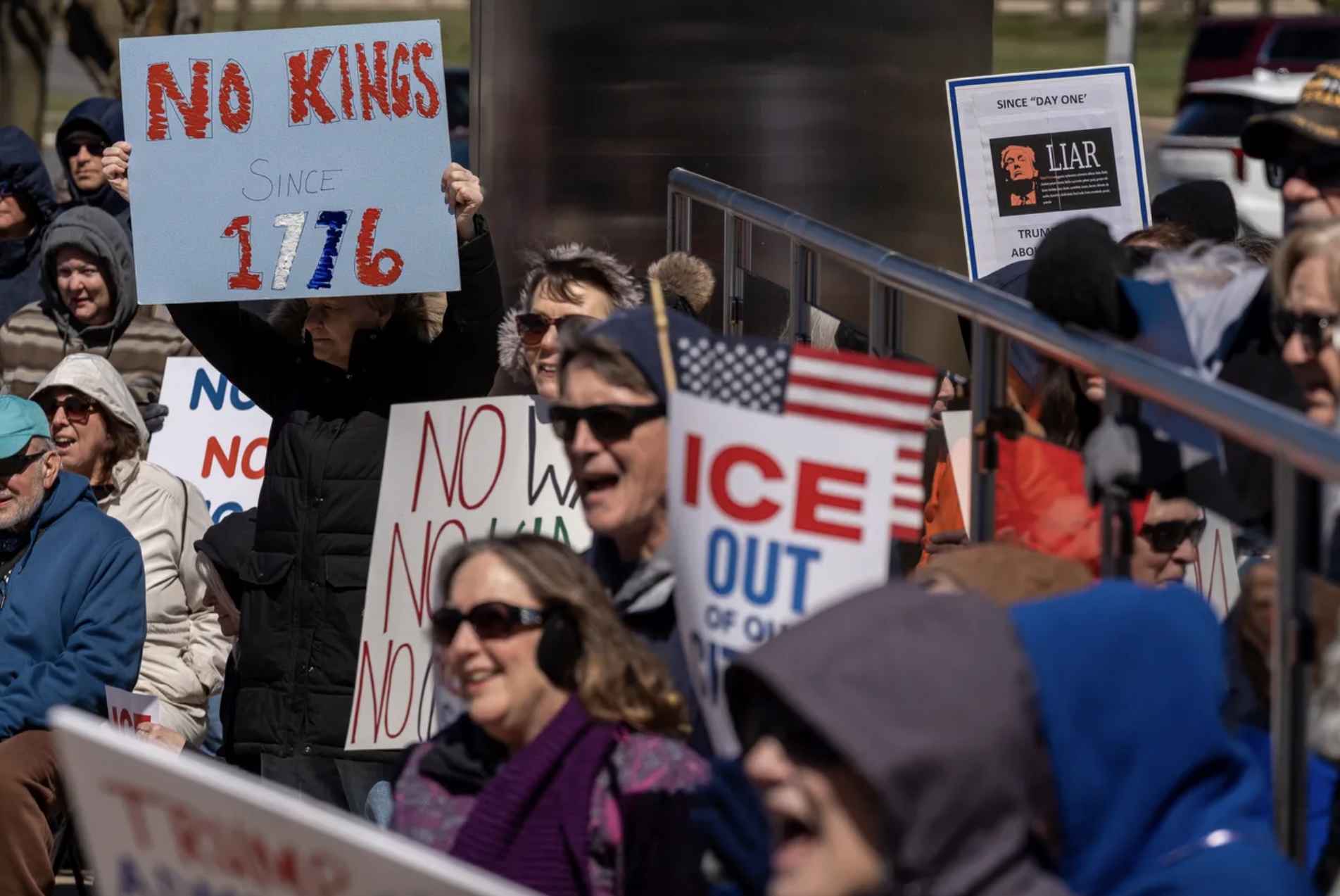
Protestors hold up signs during a No Kings protest outside the Henry Ford Centennial Library in Dearborn, Michigan, March 28, 2026. Photo by David Rodriguez Muñoz, Detroit Free Press
During the most recent No Kings protest in Detroit, I stood on the knoll at Clark Park and listened as various speakers stirred the audience, some with tears of sadness, others with eruptions of anger. The majority of the speakers were White, Asian, and Latino. Each side of the park was flanked by groups of middle-aged and elderly Black men, markedly calm by comparison.
As the protesters began their march, I moved to the perimeter of the park and spoke with the president of Detroit 300, Arthur Edge. Detroit 300 is a volunteer organization, one of many Community Violence Intervention teams in the city.
He described their role as they monitored the protest’s safety: “We’re just out here to make sure everything runs smooth and to make sure everyone’s safe. We work in various areas of the city to improve quality of life. In this circumstance, it’s the amassing of the protest. We’re here to intervene if anything goes awry.”
When I asked what they look for in agitators, he replied, “It can be anybody. Could be you. If you’re doing something wrong, we come up and say, ‘That’s not what it’s about.’ We understand you want to voice your opinion, but we want it to be safe for everybody. We don’t want to end up on the national news for something negative. We want everything to be peaceful.”
We discussed whether people attending the protest were using their platform effectively and whether Detroit’s history was being understood. “People are voicing their opinions,” Edge said, “and if you’re following what’s going on, the murder rate in Detroit has been the lowest it’s been in decades. Things are changing, but it takes everybody working together: the people, the community, the Detroit Police Department. Everybody working together to make things happen, to improve the quality of life, not only in Detroit but around the world.”
When asked what he would like to see in the country more broadly, especially among young people, he added, “Everybody getting along, respecting each other. That’s a start. People coming together, doing it respectfully, working together. Stop the violence. Young people want to be the top person in charge, but everybody can’t be in charge. If everybody works together, the mission is accomplished.”
On the opposite side of the park, a second group had assembled. I spoke with Toson Knight from Ceasefire Detroit, an organization working to end violence in the community.
Knight stated that they aim to “Prevent violence. When things happen, we try to go out and help. We want to make sure nobody comes out here to create trouble. We’re here to support. We meet with young people, mentor them, attend funerals, support families who have lost loved ones, and mediate situations where there’s tension.”
Knight urged young people to become more involved: “Come out and really help. Be community-oriented. People need to see others doing positive things; they need that support. Ceasefire Detroit could really use the help.” When I asked what he would like to see for America, his answer was, “A less violent place.”
After speaking to the two men, I considered the contrast between the speakers, the crowd and the organizations Edge and Knight represented. While one speaker visibly trembled with agitation and repeatedly called on the audience to “make America ungovernable,” the members of Ceasefire Detroit and Detroit 300 were not expressive but steady and restrained. When given a platform, Black men and women can’t afford to display anger. The stakes in historic African American protest movements have been extremely high due to the violence inflicted on the demographic. Organizations like Ceasefire Detroit and Detroit 300 understand the necessity of maintaining patience and a reasonable degree of unification.
My mind was drawn to the successes of historic Black activism and the question of whether–or not–this could become the standard for evaluating modern protest movements. The Montgomery Bus Boycott was not a spontaneous moment of protest but a sustained, 13-month campaign rooted in discipline, strategy, and community sacrifice. It is often associated with Rosa Parks, whose refusal to give up her seat became the catalyst, but Parks was not the first.
A network of Black women, including activists like Claudette Colvin and others, had already challenged segregated buses, to great personal risk. What followed was a coordinated boycott that required thousands of Black residents to walk, carpool, and endure daily hardship for over a year, ultimately leading to a Supreme Court ruling that segregation on public buses was unconstitutional.
A decade later, the Selma to Montgomery marches further demonstrated the power of sustained, strategic protest. Marchers faced brutal violence, most notably on “Bloody Sunday,” yet persisted in their efforts, helping to galvanize national support for the Voting Rights Act.
The Civil Rights movement, and these targeted efforts, illustrate that meaningful progress in America has historically depended not on momentary outrage or emotional release, but on endurance, moral clarity, and a willingness to persist over time despite resistance. Edge and Knight, along with Ceasefire Detroit and Detroit 300, are doing the unglamorous work that sustains communities.
The messaging from speakers was disparate and vitriolic during the event at Clark Park. Of the ten tables present, nine were draped with keffiyeh. At the second location, Grand Circus Park in downtown Detroit, the visual aspect of the event was similarly overshadowed by the iconography of communist and post-revolution Iranian flags. Multiple tables were adorned with the hammer and sickle, and communist manifestos were being handed out by party members dispersed in the crowd.
While some individuals attending the protests referenced patriotic ideals, the lack of cohesion in goals was underscored by the reference and promotion of these undemocratic and illiberal regimes. The No Kings speakers and attendees were rightly animated by outrage at what the Trump administration has done, but need to heed this warning from history. Eventually, something will fill the vacuum where adequate, aspirational governance once sat. No Kings lacks the Civil Rights heritage that Ceasefire Detroit and Detroit 300 brought to the Clark Park demonstration.
When political tensions rise, and protest rhetoric becomes anti-American or incoherent, it risks pushing the persuadable middle toward the political right. This is evidenced in the U.S. Instead of seeing genuinely populist frustrations being addressed, we’ve seen the rise of a cult of personality. The allure of a “conservative” party promising order, honesty, and national cohesion has been fully empowered while revealing itself to be chaotic, corrupt and divisive.
The stakes for the democratic world are swiftly increasing due to wealth inequality. The growing divide in America is between democratic and undemocratic values. While the No Kings demonstrations reject the undemocratic values that Trump represents, in desperation, protest and anger have displaced stewardship and civic responsibility. Niche causes compete with ideological unification. The stated aims of movements like No Kings to restore basic democratic principles are being drowned out by agendas that moderate voters are unlikely to sympathize with.
Americans need a set of principles to coalesce around. A return to classical liberalism that centers on belief in constitutional ideals, civic responsibility, dignity, order, and mutual respect could pave the road to reform of our national project.