
Information Overload
Gallery
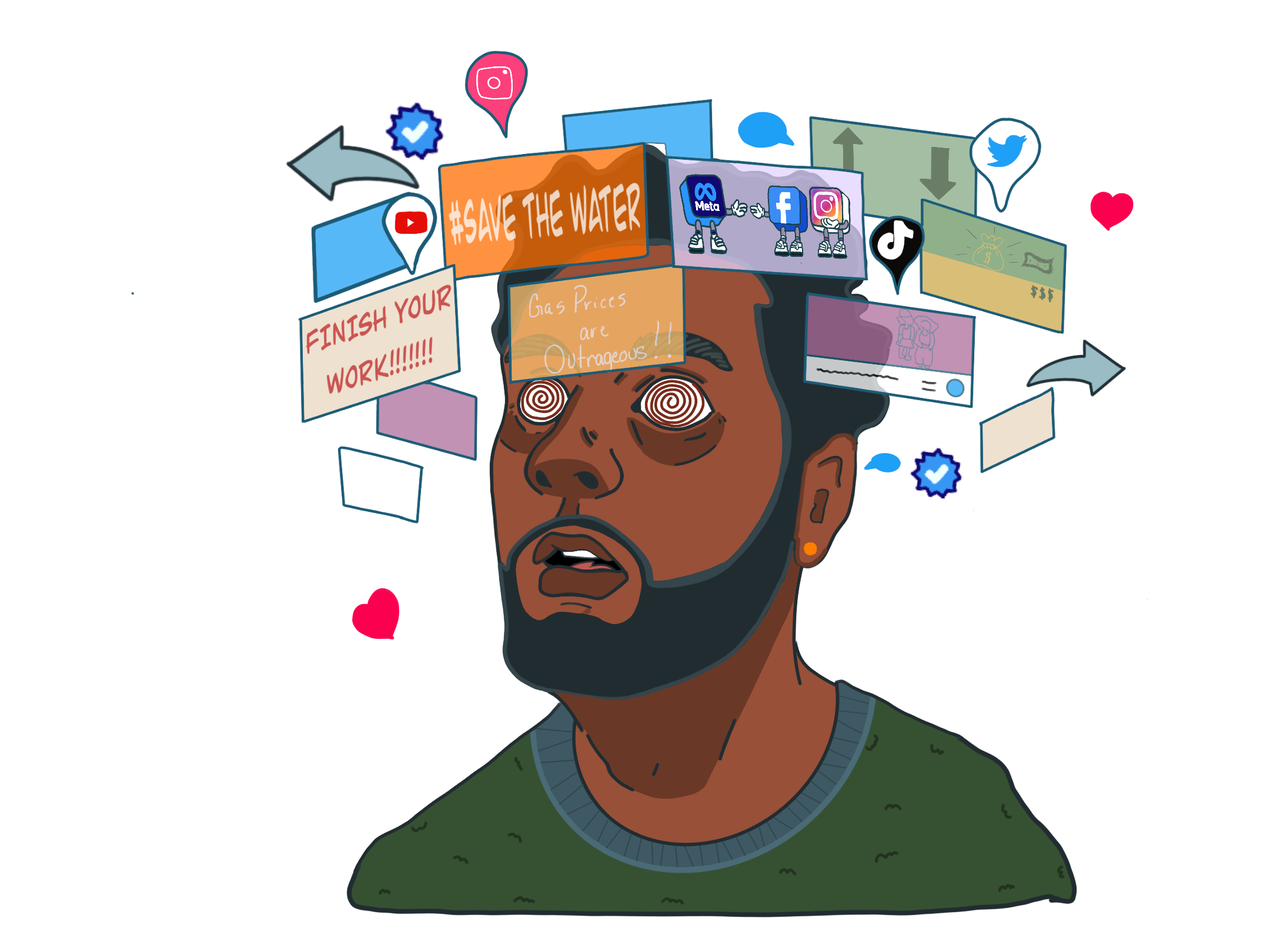
Information overload can take its toll on all of us. Henry Ford College Honors student Liaan Milhem is no exception: “Information overload has definitely made it harder to focus on schoolwork because there’s always something competing for my attention,” she stated, adding that trying to combat the “extra noise” of social media impacts her productivity and stress levels.
Reflecting on her teenage years, Milhem describes her experience with social media as constant comparison that affected her socially and created pressure to keep up. Her evolving experience with social media highlights a shift from the social pressure of adolescence to an awareness of its influences on attention and mental productivity.
The rush of dopamine and short-form video consumption may affect the brain’s ability to retain memory and decipher what information is true and what is not. Doomscrolling, reward signaling, and instant validation fuel users into wanting more. In recent years, researchers, lawmakers, and the public have begun examining the role social media plays in society.
Legal battles have gained traction as evidence suggests that minors participating in social media have an increased risk of depression and suicidality, according to a 2018 review in the “Indian Journal of Psychiatry.” The second leading cause of death in minors is suicide.
Meta Platforms (formerly Facebook) is at the forefront of controversy. Former employee and whistleblower, Frances Haugen, released internal documents in 2021, revealing findings in Meta’s Teen Mental Health Deep Dive study. The study concluded that out of the 2,503 teenagers surveyed in the United States and the United Kingdom, 82% reported a negative emotional impact. One in five teenagers reported thoughts of self-harm or suicide, further validating the findings in the “Indian Journal of Psychiatry.” Public awareness of the leaked findings from Meta’s Teen Mental Health Deep Dive study became the cornerstone of lawsuits alleging social media harm filed from 2022 to the present.
Regarding product approach, Mark Zuckerberg stated in a recorded deposition presented during the New Mexico trial, which examines platform design and youth safety concerns, “I care a lot about not cracking down on the ways that people can express themselves, and there’s, like, always been a lot of pressure to do that and censor our services.” Zuckerberg explained, “I didn’t find any of the anecdotal examples that people used to be convincing that it was actually clear evidence that this was going to be harmful.” The anecdotal examples he cited were individual experiences, which he suggested have no conclusive evidence of harm.
As of March 24, Meta was held liable for an estimated $375 million in damages.
Section 230 (47 U.S.C. § 230) of the Communications Decency Act of 1996 states that users and platforms cannot be held liable for third-party content. Liability protection for platforms enables users to express themselves freely. However, platforms can moderate posts for harmful content such as harassment. While Section 230 protects platforms from liability for user-generated content, it may not protect against the platform’s design, as the full extent of Section 230’s protections is still under debate in the courts. Features such as “For You” pages, post reactions, and infinite scrolling are examples of platform design elements currently under legal debate.
Tanya Brooks, a licensed mental health counselor and owner of Empowerment Counseling Services, explains, “Social media can have either a negative or positive impact depending on your ability to effectively manage appropriate and supportive input.” Brooks adds that people who form their behavioral interactions and beauty standards based solely on social media struggle with mental health when those expectations do not match reality.
According to Brooks, factors that contribute to a healthy relationship with social media include using it as a tool for positive support while limiting excessive use. When used responsibly, social media “can be utilized as a way to support inclusion and diversity across the board,” Brooks says.
The effects of social media vary from teen to teen, according to the Mayo Clinic. A survey of 1,300 respondents ages 13 to 17 reported that 35% of teens were active on at least one of the following social media platforms: Facebook, YouTube, TikTok, Instagram, and Snapchat. The survey found that social media has both healthy and unhealthy effects on mental health, influenced by factors such as what a teen views and participates in online, the amount of time spent online, maturity level, underlying mental health conditions, and personal life circumstances.
Unhealthy social media use may distract teens from academics, disrupt sleep, and form unrealistic views of bodily autonomy. Additionally, teens may be exposed to misinformation and online rumors, and can be susceptible to online predators.
Parents are encouraged to set rules and limitations on social media. Proactive parental support, including monitoring teens’ accounts, turning on privacy settings, and encouraging face-to-face connections with friends, can help facilitate a healthier relationship with social media.
The “analog” trend is a growing cultural movement in 2026. The movement aims to reduce screen time and AI-generated content while encouraging physical activities and hobbies that connect the mind and body. Activities such as knitting, baking, and gardening are hands-on and naturally more socially connected. Organizational psychologist Dr. Ella F. Washington wrote in a LinkedIn post, “This is not about rejecting technology or romanticizing the past. It is about deciding when you are done serving your devices for the day.” Washington’s post emphasizes that although avoiding screen time altogether in the digital age is unrealistic, people can still be intentional about when to log off.
“I’ve been more intentional by setting small limits for myself,” said Milhem. She explained that she focuses on putting down her phone in the morning and throughout her studies. By setting a time limit on social media and utilizing silent mode on her phone, she can stay focused.
Many teens are still developing the awareness and self-regulation needed to maintain a healthy relationship with social media. The future of youth protection against potential targeting on social media is an ongoing legal debate in courtrooms. Parental guidance and platform accountability remain the main focus in protecting young users during ongoing legal uncertainty.
Brook’s recommendation is “to set reasonable limits and expectations, along with choosing not to expose yourself to unhealthy sites, along with excessive time on social media, where you feel inferior to individuals you perceive as your peers.”