

Editorial: Climate Refugees Deserve Human Rights
Gallery


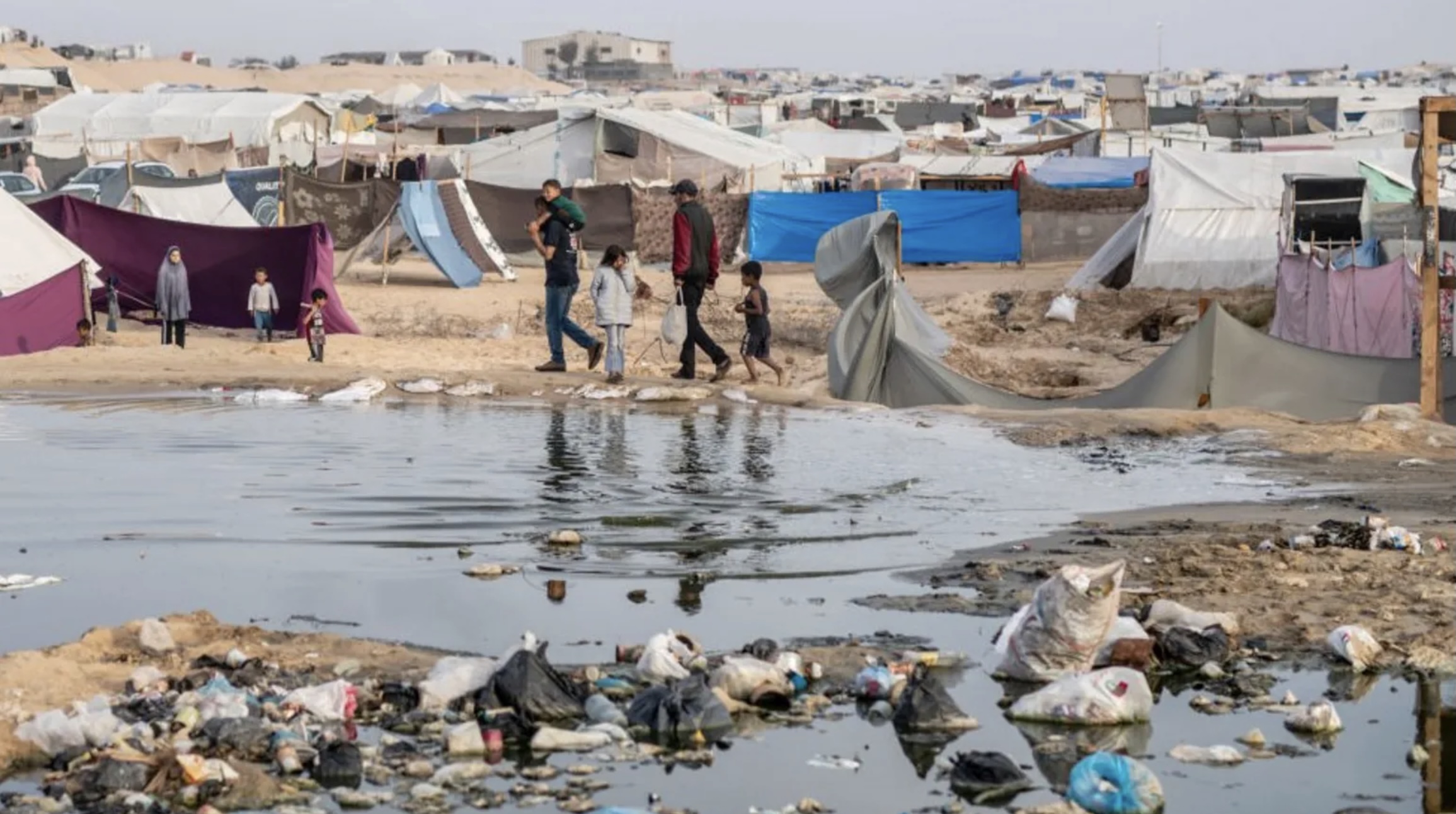
Accumulated sewage is contaminating Gaza's water supply - Rafah, April 24, 2024. Photo courtesy of BBC.
In Dec. 2025, one-third of the remote Pacific Island country, Tuvalu, applied for climate visas in hopes of migrating to Australia. This low-lying country is one of the first to experience the devastation of rapid climate change. Rising sea levels are flooding Tuvalu, and its islands are projected to be 90% covered by ocean by the end of the 21st century.
Climate change encompasses both environmental issues and humanitarian crises. A record 32.6 million people in 2022 were forced from their homes due to shifting temperatures, rising sea levels, mass droughts, and ecocide. Climate-driven migration is becoming a rapidly growing norm, particularly in “developing” nations.
The data on climate-induced migration, the urgent need to include environmental factors in global migration policies, and displaced communities’ efforts to maintain their cultural roots despite devastating displacement show the need to act now, not later.
Bolivia is a landlocked country in West-Central South America, which is known for its beautiful landscapes and geography. In the highlands, the Ura Chipaya, one of South America’s oldest indigenous people, are watching their own homeland slowly disappear.
Farmers who were once dependent on fertile soil and endlessly flowing rivers are now struggling to grow crops and make ends meet. The routine they once built is slowly falling apart, and most importantly, the known “people of the water” have found themselves facing numerous glimpses of extinction due to the severe droughts.
Lake Poopó, located in the Oruro Department of southwestern Bolivia, is nearly drying up. The lake is considered Bolivia’s second-largest and is crucial for nearby communities. The consequences are many, including the destruction of the fishing environment and a cultural crisis. These consequences have led to the forced migration of many indigenous families, losing their livelihood and a place that was once their generational home. The rates of poverty have risen to extreme levels.
This drought not only affects the community but also the environment. The drought in Lake Poopó has destroyed many habitats and, subsequently, the species that live in the lake. Over 75 bird species have been lost due to habitat loss on Lake Poopó. Additionally, frequent dust storms occur due to the dry, desiccated soils and cracked earth.
In his article, “We’re in Danger of Extinction,” journalist Brian Bien interviewed the indigenous people of Bolivia to bring awareness and gain insight into what’s happening in their country. A Bolivian native, Sebastián Quispe Lázaro, said, “When I was a child, the sky was always blue this time of the year. Now we have all four seasons in one day. The weather has changed completely. With this frost, it’s damaging the grass; it has no vitamins left. Animals stay thin when they eat that grass. And in September and October, they die.”
Yet even as the lands crack and the rivers dry up, the people of Uru Chipaya hold onto hope, tradition and culture. Generations of hard-working individuals continue to maintain their language and keep its lively cultural roots despite the crisis.
The Mirror News urges readers to support organizations like the Pan American Health Organization (PAHO) and Cooperazione Internazionale (COOPI) that invest in initiatives such as vaccinations for the Uru Chipaya people and support their community resilience. Supporting the Uru Chipaya would mean advocating for sustainability in their environment and a more comfortable way for them to adapt to climate change while still carrying on their cultural heritage and traditions.
The disruption of everyday life and culture, as we see in Bolivia, is illustrated most devastatingly in Palestine.
The ongoing devastation in Palestine has surpassed the metrics of regular warfare; it has completely entered into what international legal experts and scientists are now defining as ecocide. This systemic erasure of the landscape is not only a byproduct of genocide; it is a catalyst for a new and permanent generation of Palestinian climate refugees. By rendering once-fertile land inhabitable, the ecocide of Palestine creates an environment that facilitates the forcible displacement of its people.
In the Gaza Strip, the scale of environmental destruction is completely unprecedented, with the country being described as an “uninhabitable death zone”. Satellite analysis revealed that by Oct. 2025, 98% of Gaza’s tree cropland had been destroyed by military activity. This decimation includes the systematic uprooting of citrus and olive groves, both of which are large historical pillars of the Palestinian economy. The olive groves contribute 14% to the total output. Furthermore, the accumulation of 61 million tons of toxic debris, which is equivalent to 365 kg for every square meter of Gaza, contains human remains, asbestos, and unexploded military supplies, which will take an estimated 14 years to fully clear.
The environmental assault extends to the West Bank, where Palestinians face green colonialism and environmental apartheid. Since 1967, over 800,000 olive trees have been illegally uprooted by Israeli authorities to make way for settlement expansion and military zones. Additionally, the West Bank has become a dumping ground for 60,000 tons of Israeli electronic waste annually, which is burned in open-air sites, releasing carcinogenic toxins into the air and groundwater.
Perhaps the most enduring legacy of this ecocide is the total collapse of water and sanitation infrastructure. Prior to the escalation of the war two years ago, 97% of Gaza’s sole freshwater source, the Coastal Aquifer, was already unfit for human consumption. The increased genocide since Oct. 7, 2023, has completely rendered all six major wastewater treatment plants inoperative, leading to the daily discharge of 130,000 cubic meters of raw sewage into the Mediterranean Sea and onto residential soil.
The hydrological catastrophe is compounded by the deliberate flooding of underground tunnels with seawater, which risks permanently over-salting the aquifer, which is an underground layer of water-soaked rock that acts as a natural storage tank for groundwater, beyond the point of technical recovery.
Health workers report that this lack of clean water has triggered the re-emergence of the poliovirus. Pedro Arrojo-Agundo, the U.N. special rapporteur, has claimed that this deprivation is being used as a “weapon of war” against the civilian population.
While the 1951 Refugee Convention does not yet recognize “climate refugees” as a formal legal status, the reality in Palestine is that ecological collapse and political dispossession are now inseparable. Climate change acts as another push in the region. Temperatures are rising 20% faster than the global average, and the annual precipitation is projected to decline by up to 30% by the end of the century.
This environmental Nakba, or forced displacement, forces communities out of rural areas as traditional herding and rain-fed agriculture become impossible to maintain due to military restrictions and climate-induced water scarcity. In Gaza, over 1.9 million people are displaced, and the people sheltering along the coastal strip are receiving as little as 2 liters of water per day. As the land is stripped of its trees and its soil is poisoned by leftover military residue, return is becoming more and more impossible.
Restoring the ecological structure of Palestine is now an important foundation for any future peace. Without intervention, large portions of the Palestinian territories will become permanently uninhabitable by 2050. For the people of Palestine, ecological determination remains one of their biggest tools of resistance, as they continue to plant olive trees in the ruins of the ongoing genocide.
Across the globe, it is projected that over 200 million people will be displaced by climate change by 2050. Climate change aggravates existing scarcities of food and water, forcing communities to choose between migration and destruction.
While international law protects those fleeing persecution, it offers little solace to those fleeing a destroyed environment. Despite being on the frontline of climate disasters, “climate refugees” exist in a legal gray area, lacking the formal recognition of conventional refugees.
We have reached a new era where climate-induced migration will become more common. Ignoring the reality of climate refugees is no longer an option; the futures of those devastated by climate change rely on policy recognizing their displacement. Globally, there needs to be stronger solidarity with suffering nations and a legal pathway for climate refugees. It is their human right to seek refuge and be provided a safe place to live and grow.