

Beyond the Headlines: Yemen’s Architecture at Risk
Gallery


For over a decade, Yemen has been defined internationally by images of conflict, displacement, and humanitarian crises. What receives far less attention is another casualty of war: the country’s historic architecture. As conflict continues and instability reshapes daily life, centuries-old buildings, some of the most unique in the world, face destruction, neglect, and slow decay.
Yemen’s architectural heritage is not limited to one city or monument. It includes the Old City of Sana’a, the vertical towers of Shibam, the dramatic cliffside palace of Dar al-Hajar, and the historic Cairo Castle in Taiz, among many other villages, mosques, markets, and fortresses across the country. Together, they represent centuries of creativity, adaptation, and cultural identity. Today, they stand in the shadow of war.
The Old City of Sana’a is one of the clearest examples of what is at stake. Its multi-story tower houses, built from sun-dried mudbrick and decorated with white gypsum patterns, rise closely together in a dense, intricate skyline. Some of these homes are more than 500 years old. Families still live in them. The architecture reflects both environmental intelligence and social structure. Thick earthen walls regulate temperature naturally in Yemen’s harsh climate. Upper floors were traditionally used for hosting guests, reflecting cultural values of hospitality and community.
Since the escalation of conflict in 2015, parts of Sana’a’s historic district have suffered damage from airstrikes and nearby explosions. Even when buildings are not directly hit, shockwaves can weaken foundations. More quietly, the war has disrupted the maintenance that mudbrick structures depend on. These buildings require constant care; outer layers must be replastered to prevent erosion, cracks must be repaired, and drainage systems must function properly. When resources are scarce and survival takes priority, preservation becomes nearly impossible. The result is gradual deterioration that may be just as destructive as bombs.
Further east, Shibam offers another example of architectural brilliance under threat. Often called the “Manhattan of the Desert,” Shibam contains what many historians consider some of the world’s earliest skyscrapers. As early as the 16th century, residents were building mudbrick towers reaching up to eleven stories high. The city was designed vertically, inside fortified walls, as a response to security threats and limited space. Long before modern steel high-rises, Yemeni builders had already developed complex vertical buildings using only earth and wood.
Yet the very material that makes Shibam extraordinary also makes it fragile. Mudbricks demand continuous upkeep. Without it, rain and wind slowly wear away walls. Conflict disrupts not only physical repair but also the transmission of traditional craftsmanship.
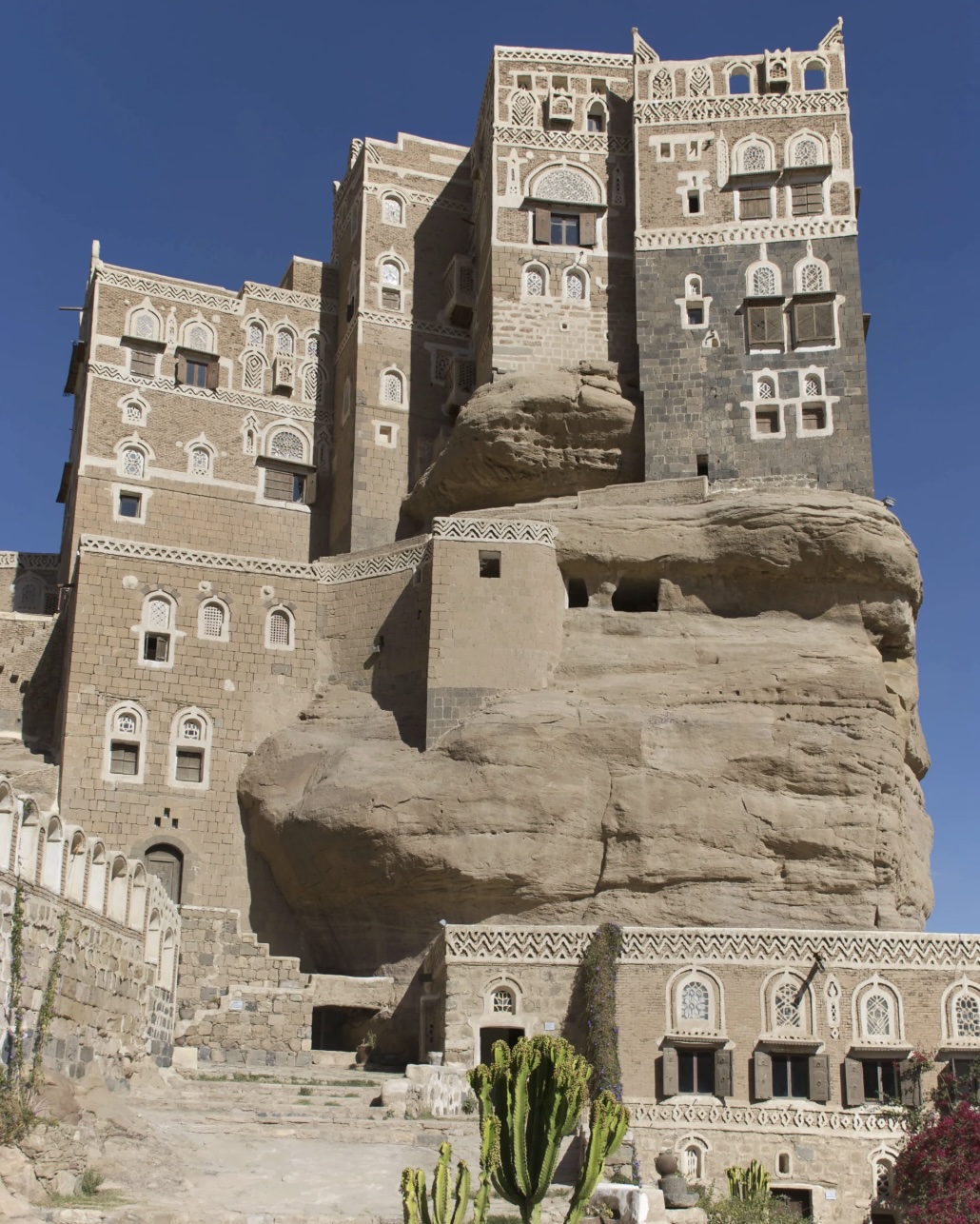
Landmarks like Dar al-Hajar and Cairo Castle reflect other dimensions of Yemen’s architectural history. Dar al-Hajar, built dramatically atop a massive rock formation, demonstrates a deep connection between architecture and landscapes. Cairo Castle, overlooking Taiz from a strategic hilltop, reflects centuries of political change and defense. Both sites, like many others across Yemen, have increased vulnerability due to existing in an environment of instability that limits restoration efforts.
The destruction of these sites is not only a cultural issue, but also a socio-economic one. Before the war intensified, Yemen’s historic cities attracted visitors, researchers, and architects from around the world. Cultural tourism provided income to artisans, guides, and local businesses. Preservation was not just about protecting the past; it supported livelihood. As tourism has declined and infrastructure has suffered, communities have lost both income and incentive to maintain historic buildings. It is understandable that during a humanitarian crisis, immediate survival needs come first. However, architecture is not separate from recovery. Historic buildings carry memory and identity. They offer continuity in disruption. When a country eventually begins to rebuild after conflict, cultural landmarks provide more than aesthetic value; they provide symbolic foundations. They remind communities of who they are and what they have endured.
Despite enormous challenges, efforts continue to protect what remains. Residents repair homes when possible. For future restoration accuracy, some preservation initiatives focus on documenting damage through photography and digital mapping. Young Yemenis continue to learn traditional construction methods to keep the knowledge alive even in unstable conditions. These acts of preservation may seem small, but they represent resistance against cultural erasure.
War destroys quickly. Architecture takes generations to create. Yemen’s historic cities and landmarks are more than beautiful structures. They are records of human ingenuity, sustainability, and resilience. They prove that advanced urban planning and environmentally responsive design existed long before modern engineering. Losing them would mean losing irreplaceable chapters of global history.
During the ongoing conflict, protecting Yemen’s ancient and historic architecture is not a secondary concern. It is an investment in the country’s long-term recovery. If these buildings disappear, something deeper disappears with them. Ensuring their survival means ensuring that when peace eventually returns, Yemen still has the physical foundations of its history and a tangible connection to rebuild from.