

The Psychology of New Year’s Resolutions: Why We Fail
Gallery
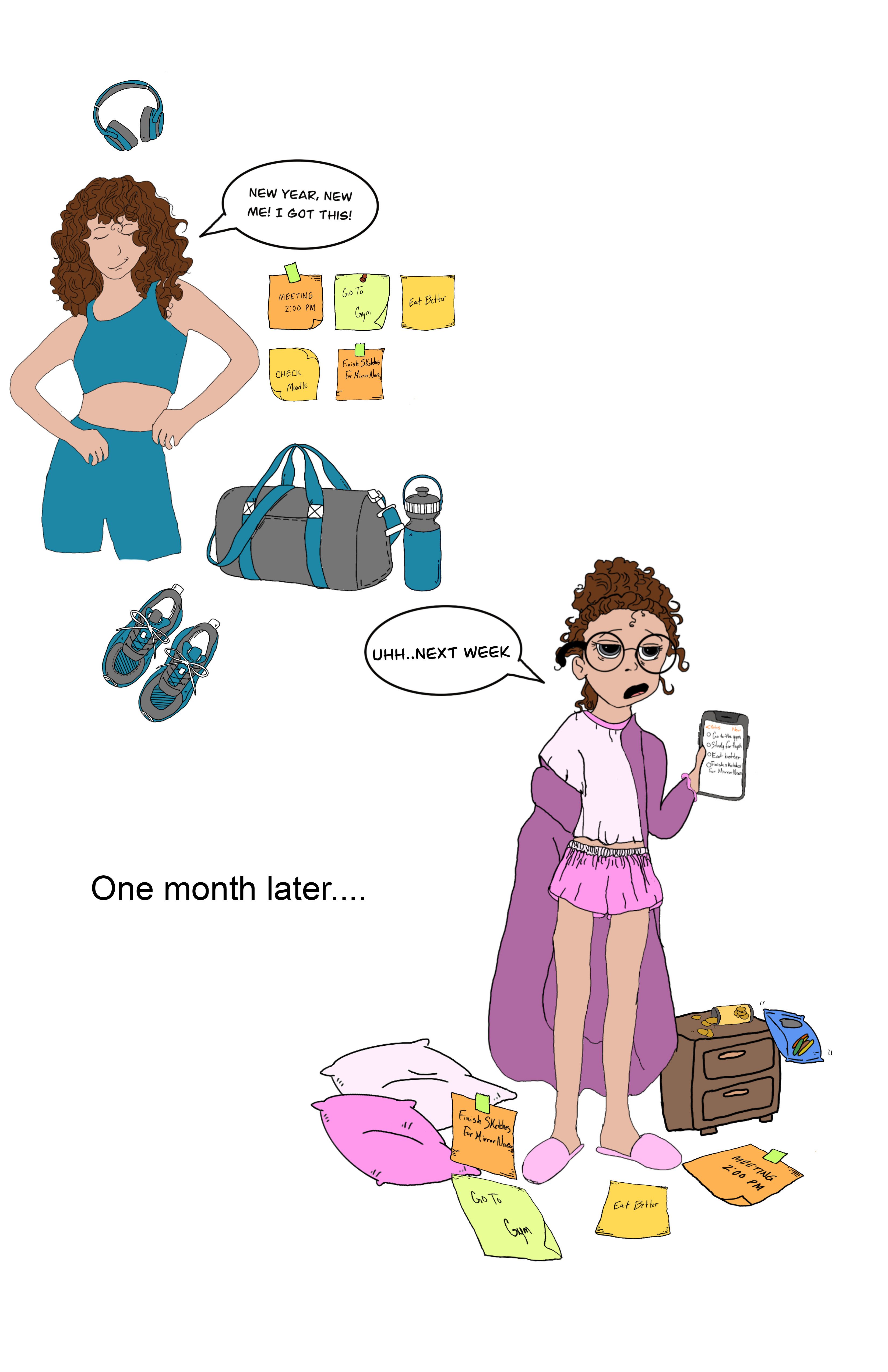
On a crisp January 1, Sarah sits in the campus café with her friend Maya, watching the clock tick into a new year. She’s been mentally cataloging her resolutions all morning. “Okay, this year I’m going to be different,” Sarah says, pulling out her phone to add to her notes. “I’m going to ace all my classes, hit the gym five times a week, learn Spanish, eat better, and sleep more. Maybe take up meditation. Oh, and I’m definitely cutting out junk food completely.”
Maya takes a bite of her muffin and raises an eyebrow. “All of that? Starting right now?”
“Starting right now,” Sarah confirms, dead serious.
By January 5, the plan already feels overwhelming. The language app is unopened, the gym feels like a distant memory, and meditation is completely off the table. By the third week, the gym bag by the door and the untouched language app tell a familiar story. Sarah finds herself falling back into old habits, stress-eating while scrolling through her phone during library study sessions.
If this sounds like you–or literally everyone you know–you’re not alone. About 80% of people abandon their New Year’s resolutions by February. But here’s the thing: this isn’t a personal failure or a sign of laziness. It’s science.
There’s actually a psychological phenomenon that explains why January 1 feels like such a big deal. Researchers call it the “Fresh Start Effect.” When we hit a natural temporal landmark, the new year, a new semester, or even a Monday, our brains trigger a reset button. We suddenly feel like our past failures are behind us, and our future is wide open.
This initial feeling creates a real dopamine spike. Dopamine is the brain’s feel-good chemical, and it genuinely makes us feel motivated and optimistic. The problem is that a dopamine high is temporary. When reality sets in, when you realize how hard it actually is to wake up for 6 a.m. workouts or when you miss a day, the motivation crashes hard.
That’s not a weakness. That’s just how our brains are wired.
And here’s where most resolutions fail before they even start. We make resolutions that sound good but are impossibly vague: “eat healthier,” “exercise more,” “be more productive.” These sound inspiring in the moment, but your brain can’t actually act on them.
Your brain is literal. It needs specifics. When you say “eat healthier,” your brain has no idea what that means or how to execute it. Should you add a salad? Cut out sugar? Eat at different times? The ambiguity creates confusion, and confusion leads to procrastination. Without a clear roadmap, your limited initial willpower quickly gets exhausted. Compare that to a specific goal: “Eat one serving of fruit with breakfast on weekdays in January.” That’s concrete. Your brain knows exactly what to do. It’s easier to succeed because you know exactly what success looks like.
Neuroscience tells us that habits are formed through something called the “cue-routine-reward” loop. A trigger happens, you do the behavior, and you get a reward. That reward tells your brain, “do this again.”
When you make a new resolution, you’re trying to break an old, comfortable, rewarding loop and replace it with a new one. But here’s the catch: your brain doesn’t immediately find the new behavior rewarding. So, you’re fighting years of built-in habit patterns with pure willpower. Unfortunately, willpower rarely wins the battle. That’s why most people give up in the first few weeks. The satisfaction of the new behavior isn’t strong enough yet to beat the comfort of the old one.
The question is: Are you making this resolution for you, or are you making it because you think you should?
This is the difference between extrinsic and intrinsic motivation. Extrinsic motivation comes from outside sources, such as social pressure, a desire to look good, and following a trend. Intrinsic motivation comes from inside. It’s rooted in your personal values and what matters to you.
The research is clear: resolutions driven by intrinsic motivation last. Those driven by external pressure don’t.
Let’s say you resolve to get fit. If it’s because you feel pressure to look a certain way, it most likely won’t stick. But if it’s because you want to have more energy for your classes, or you want to be healthier for your future, or you genuinely enjoy how exercise makes you feel, that’s intrinsic. That’s the motivation that survives when the initial excitement wears off.
One of the biggest mistakes is the “all-or-nothing” approach. You decide to overhaul your entire life overnight. You’re going to work out two hours a day, meal prep every Sunday, wake up at 5 a.m., and sleep perfectly.
This approach overwhelms your brain’s resources. You’re asking your brain and body to handle massive changes all at once. The result: Burnout, frustration, and giving up.
The science supports a different approach: small, incremental changes. Instead of training for a marathon, commit to a 15-minute walk three times a week. Instead of cutting out all junk food, swap out one snack for something healthier. Instead of waking up at 5 a.m., try 6:30 a.m.
These tiny wins matter. Each small success builds confidence and makes the behavior feel more automatic. As James Clear explains in his book “Atomic Habits,” you don’t rise to the level of your goals; you fall to the level of your systems. Small changes might seem insignificant, but they compound over time. Research shows it takes about 66 days on average for a new behavior to become truly automatic. Smaller steps make those 66 days doable.
Additionally, your environment is doing an abundance of the work. Or, if it’s not set up right, it’s working against you.
If your room is stocked with instant ramen and energy drinks but no fruit, you’re fighting an uphill battle every single day. If your gym clothes are hidden in a closet but your Netflix remote is on your nightstand, which do you think you’re more likely to reach for?
This is called “stimulus control,” and it’s surprisingly powerful. It’s not about willpower. It’s about removing temptation and making desired behaviors the path of least resistance.
Want to eat better? Keep healthy snacks visible and accessible. Want to exercise? Lay out your gym clothes before bed. Want to read more? Put your book on your desk instead of your phone.
Small environmental tweaks remove the need for constant willpower. Your environment just gently nudges you in the right direction.
You don’t have to do this alone, and you probably shouldn’t. Sharing your goals with friends, family, or even an online community creates accountability. When someone else knows what you’re trying to do, you’re less likely to abandon it. Plus, they can encourage you when things get hard.
It is also important to recognize that setbacks are inevitable: missed workouts, unhealthy choices, or falling behind may happen. What often causes people to give up is viewing a single slip-up as total failure. Those who successfully maintain their goals adopt a different mindset: they accept setbacks as ordinary, reflect on what went wrong, and resume their efforts without guilt or self-criticism. This flexible approach is more effective than rigid perfectionism, as it prioritizes consistent effort, continuous improvement, and learning from setbacks while celebrating small successes.
Science points to a clear framework for success. Be specific about your goals, not vague. Walk for 15 minutes three times a week, not just “exercise more.” Start small rather than attempting massive overhauls that overwhelm your system. Connect your goals to your core values so you’re driven by genuine motivation, and not external pressure. Design your environment to make desired behaviors the easiest option. Find accountability through friends, family, or communities that support your efforts. And crucially, forgive yourself when you slip. Progress, not perfection, is what sustains change.
The real insight here is simple but powerful: the failure rate of New Year’s resolutions has nothing to do with your willpower or discipline. It’s fundamentally a mismatch between how we approach change and how our brains are wired to sustain it. You don’t need grand promises on January 1. You don’t need to reinvent yourself overnight. What you need is one small, deeply personal commitment, built gradually with patience and support. This year, replace the list of impossible promises with a single, strategic habit. That quiet commitment to yourself, compounded day after day, is where real transformation begins. That’s not just how change happens. That’s how lasting change actually becomes who you are.