

The Placebo Effect
Gallery
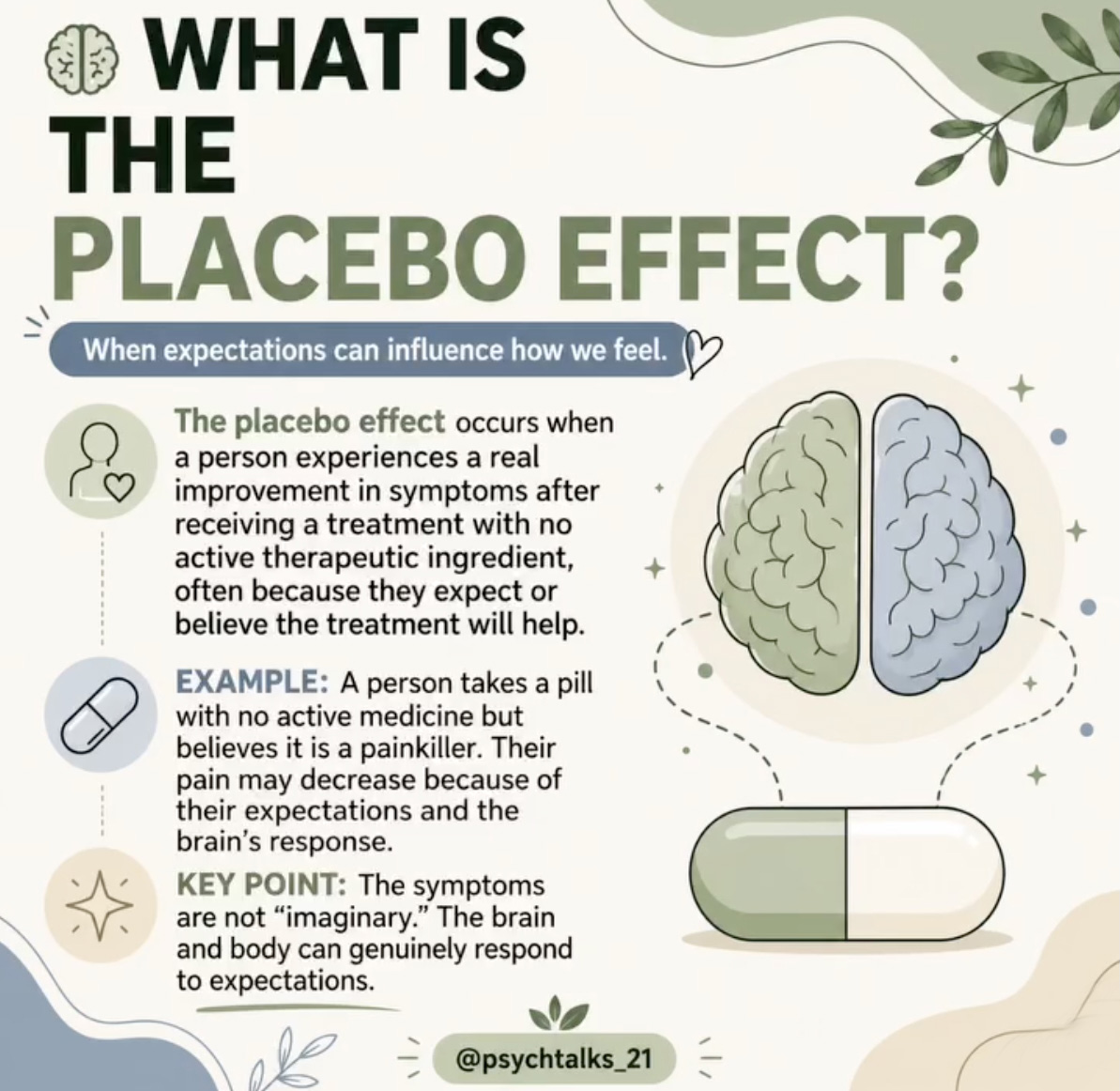
A pill can contain no medication and still change how a person feels. Someone might take what they believe is a painkiller and report that their pain has decreased, even though the pill contains no drug designed to relieve it. This is known as the placebo effect, a phenomenon that has challenged researchers for decades and continues to raise questions about the relationship between the brain, psychology and physical health.
But does the placebo effect actually exist, or is it simply a matter of people convincing themselves that they feel better?
Research suggests that the answer is more complicated than either explanation. Placebo effects are real and can involve measurable changes in brain activity, particularly in studies of pain. However, they do not mean that positive thinking can cure any illness or that an inactive pill works the same way as an actual medication.
How does the placebo effect work?
A placebo is a treatment that does not contain the active ingredient responsible for the intended medical effect. In research, placebos are often used in clinical trials to help determine whether a medication produces benefits beyond those associated with receiving treatment itself.
The placebo effect refers to changes in symptoms or other outcomes that result from the context surrounding treatment. These changes can be influenced by a person’s expectations, previous experiences and interactions with healthcare professionals.
In a 2015 review published in Nature Reviews Neuroscience, neuroscientists Tor Wager and Lauren Atlas explained that “Placebo effects are effects of the context surrounding medical treatment.” Their research highlights how expectations, previous experiences and the environment in which treatment is given can influence how a person responds. In other words, the effect is not necessarily about the pill itself, but about how the brain interprets the treatment and what it expects to happen.
Neuroscientists Fabrizio Benedetti and colleagues explored these mechanisms in their review of, “How Placebos Change the Patient’s Brain,” published in Neuropsychopharmacology. They explained that placebo responses involve several processes, including expectation, anxiety, reward and learning. Their research highlights how the psychological context surrounding treatment can influence the brain’s response to symptoms.
One important factor is expectation. If someone believes a treatment will relieve their pain, the brain may begin preparing for that outcome before the treatment has had any opportunity to produce a pharmacological effect.
However, an expectation is not the only mechanism involved. Conditioning and previous experiences can also influence how a person responds to treatment.
For example, someone who has repeatedly taken medication and experiences relief may begin associating the pill, its appearance or the process of taking it with feeling better. Over time, similar cues may influence the person’s response even when an active medication is absent. This is a form of learned association, similar in principle to classical conditioning.
Researchers Scott Schafer, Stephan Geuter and Tor Wager examined these processes in a 2018 review published in Progress in Neurobiology. They proposed that placebo analgesia can develop through both expectations and learning from previous experiences, suggesting that the brain’s response is shaped by more than simply believing a treatment will work.
What actually happens in the brain?
The placebo effect becomes particularly interesting when researchers examine the brain itself.
Pain is not simply a signal traveling from an injured part of the body to the brain. Although the nervous system detects and transmits information about potentially damaging stimuli, the experience of pain is also influenced by attention, emotions, expectations and the brain’s interpretation of that information.
Researchers have found that placebo treatments can influence some of the neural systems involved in processing pain.
In a 2014 meta-analysis, Lauren Atlas and Tor Wager examined 25 neuroimaging studies investigating placebo analgesia, or the reduction of pain associated with placebo treatment. Their findings showed consistent reductions in activity during painful stimulation in several regions associated with pain processing, including the thalamus, insula and dorsal anterior cingulate cortex. They also found increased activity in certain prefrontal regions involved in expectations and cognitive processing.
These findings are important because they suggest that placebo responses are not necessarily limited to what someone reports feeling. Changes in reported pain can occur alongside measurable differences in brain activity.
The brain’s chemical signaling systems are involved as well. Studies have shown that placebo-induced pain relief can recruit the body’s endogenous opioid system. Endogenous opioids are chemicals produced naturally by the body that act on opioid receptors and help regulate pain.
In an influential 1978 study, Jon Levine and colleagues found that naloxone, a drug that blocks opioid receptors, could reverse placebo-induced pain relief in certain circumstances. This provided early evidence that the placebo effect could involve the body’s own pain-regulating chemistry rather than simply a person’s willingness to report feeling better.
Dopamine, a neurotransmitter involved in motivation, learning and reward, has also been implicated in some placebo responses, particularly in research involving Parkinson’s disease. However, the mechanisms vary depending on the condition being studied, and not every placebo response relies on the same biological pathway.
Is the placebo effect just psychological?
The distinction between psychological and physical effects is not as straightforward as it might seem.
Expectations, emotions and learned associations are psychological processes, but they are also supported by biological activity in the nervous system. A change in expectation can influence neural processing, which may then alter how a person experiences a symptom.
This does not mean that symptoms are imaginary. Pain, nausea and other subjective symptoms are genuine experiences, even when their intensity is influenced by psychological factors.
At the same time, experiencing less pain does not necessarily mean that the underlying injury or disease has improved. A placebo may influence symptom perception without repairing damaged tissue, eliminating an infection or correcting another underlying medical problem.
This distinction is essential when evaluating claims about placebo treatments. Researchers must examine not only whether someone feels better, but also what specifically has changed and whether that change is clinically meaningful.
Does the placebo effect actually improve health?
Although neuroscience provides evidence that placebo effects can influence the brain, researchers have also questioned how much benefit placebos provide in clinical settings.
A major systematic review by Asbjørn Hróbjartsson and Peter Gøtzsche, published in the Cochrane Database of Systematic Reviews in 2010, examined 202 trials comparing placebo interventions with no treatment across 60 health conditions.
The researchers found that placebo interventions generally produced no major health benefits. However, they observed modest effects on some patient-reported outcomes, particularly pain, although the size of the effect varied considerably between studies.
Their findings highlight an important limitation: improvements observed in a placebo group do not automatically prove that the placebo itself caused those improvements. Symptoms can fluctuate naturally, participants may improve over time, and people receiving treatment may report their experiences differently from those receiving no treatment.
To separate these possibilities, researchers compare placebo groups with untreated groups and use carefully designed clinical trials.
The evidence therefore supports a more specific conclusion. Placebo effects can influence certain symptoms and measurable biological processes, but they are not a universal treatment for disease.
What if someone knows they are taking a placebo?
Traditionally, placebo treatments have often involved participants believing they are receiving an active medication. This raises an ethical question: must someone be unaware that they are taking a placebo for it to have an effect?
Researchers have investigated this through open-label placebos, in which participants are told that their treatment contains no active medication.
A systematic review and meta-analysis published in Scientific Reports in 2023 examined open-label placebo studies involving participants without clinical conditions. The findings suggested that openly administered placebos could influence some self-reported outcomes, although the studies varied in their methods and results.
Researchers have also investigated open-label placebos in clinical populations, including people experiencing symptoms associated with conditions such as irritable bowel syndrome. These studies suggest that treatment expectations and the experience of receiving care may still matter even when participants know the treatment is inactive.
However, open-label placebo research remains an evolving field. Findings from one condition cannot automatically be applied to another, and the evidence does not establish that openly administered placebos can replace effective medical treatment.
What the placebo effect tells us about the brain?
The placebo effect demonstrates that the experience of receiving treatment can influence how the brain processes symptoms. Expectations, learning and the relationship between patients and healthcare professionals can all contribute to the response.
At the same time, it is important to recognize the limits of these findings. A placebo does not become an active drug simply because someone believes it will work, and symptom improvement does not necessarily indicate that a disease has been treated.
Instead, placebo research offers scientists a way to investigate how the brain regulates pain, processes expectations and responds to the context surrounding medical care.
The most interesting question may not be whether the placebo effect is real, but how the brain can use expectations and previous experiences to change what we feel. Understanding that connection could help researchers improve the way symptoms are managed while maintaining a clear distinction between feeling better and treating the underlying cause of an illness.