

Nobel Prize-Winning Algae
Gallery
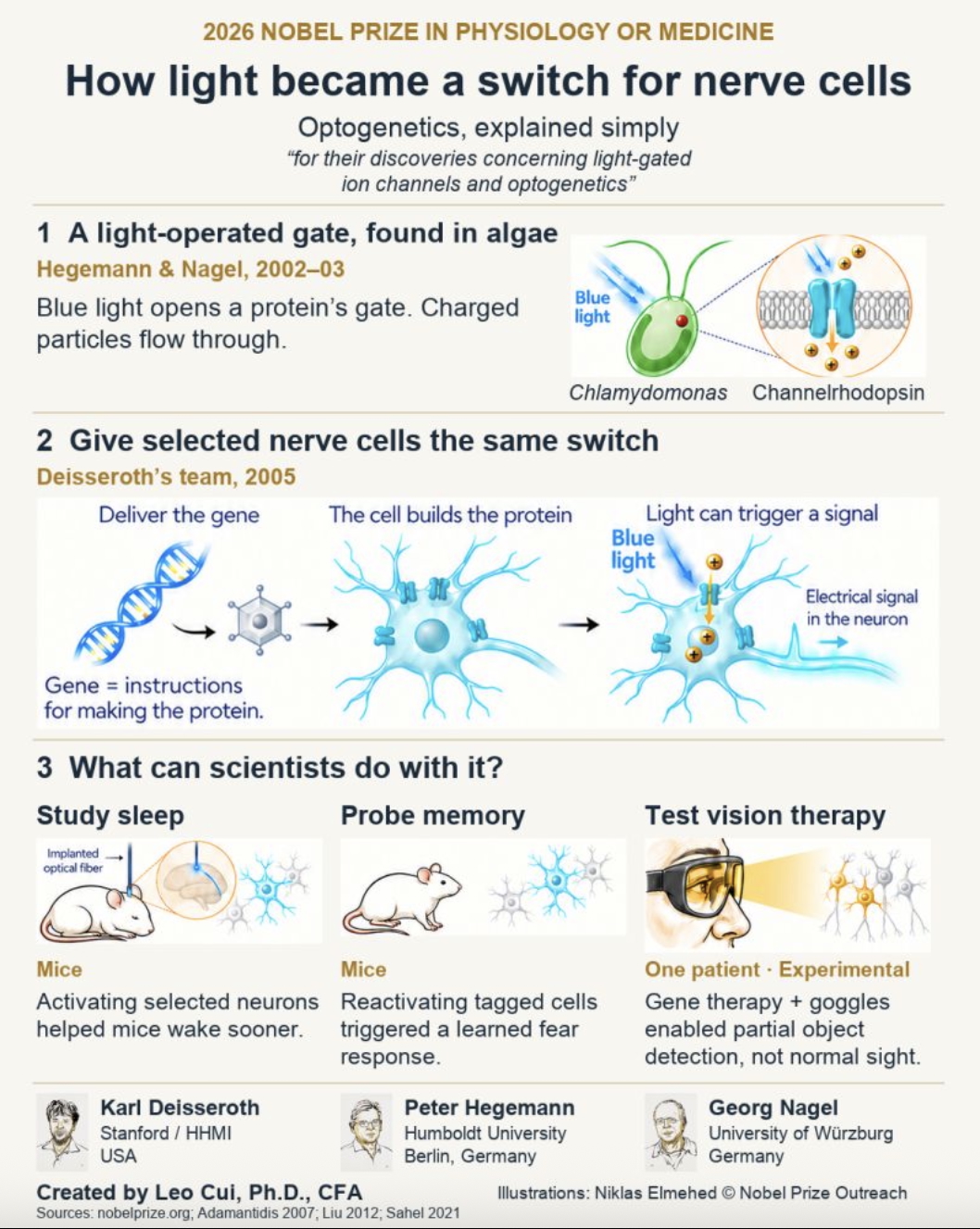
From light-sensitive protein in algae to manipulating neural circuits, optogenetics has transformed how scientists investigate the brain.
More than two decades of research connecting these seemingly unrelated subjects has earned Karl Deisseroth, Peter Hegemann and Georg Nagel the 2026 Nobel Prize in Physiology or Medicine for their discoveries involving light-gated ion channels and optogenetics. Their work helped establish a technique that allows researchers to control the activity of selected cells using light, giving neuroscientists a powerful way to learn how specific neural circuits influence behavior and disease.
From Algae to Neurons
The story began not with the human brain, but with a microscopic green alga called Chlamydomonas.
Hegemann was interested in a basic biological question: How does this single-celled organism sense light and swim toward it? Research by Hegemann, Nagel and their colleagues helped identify and characterize channelrhodopsins, light-sensitive proteins located in the cell membrane. When channelrhodopsin is exposed to blue light, the protein opens a channel that allows charged ions to move across the membrane, producing an electrical change inside the cell.
Scientists soon realized this mechanism did not have to remain in algae.
In 2005, Deisseroth and colleagues introduced the channelrhodopsin gene into mammalian neurons. When those neurons were exposed to blue light, ions moved across the cell membrane, causing depolarization and potentially triggering an action potential, the electrical signal neurons use to communicate.
This combination of genetic targeting and light became known as optogenetics. Researchers can introduce genes encoding light-sensitive proteins into selected populations of neurons. Those neurons then produce the proteins in their cell membranes. In experiments involving deeper areas of the brain, light can be delivered through thin optical fibers, allowing scientists to control neuronal activity with remarkable speed and precision.
In simple terms, researchers created a molecular light switch for selected neurons.
A Light Switch for the Brain
The importance of optogenetics goes beyond simply turning neurons on and off.
Before the technique was developed, researchers could record electrical activity or use brain imaging to observe which areas became active during a particular behavior. These methods were extremely valuable, but they often revealed correlation rather than causation.
For example, if a group of neurons becomes active when an animal experiences fear, that does not necessarily prove those neurons caused the fear response.
Optogenetics allows researchers to test that relationship more directly. Scientists can activate or inhibit a specific population of neurons and observe whether a behavior appears, disappears or changes.
This shift from observing neural activity to manipulating specific circuits has made optogenetics one of the most influential tools in modern neuroscience.
In an interview with ABC News following the Nobel announcement, Deisseroth described an important next step in the research: “Once you know what matters for function, you can ask, how can dysfunction be addressed?”
Deisseroth explained that scientists can then investigate whether certain cells contribute to dysfunction, whether other cells can counteract it, and how this knowledge might guide the development of new medications and more precise neuromodulation approaches.
This is one of optogenetics major strengths. It allows researchers to move from asking which neurons are active to asking which neurons actually contribute to a function, what happens when their activity changes, and whether that knowledge could eventually help address disease.
Researchers have used optogenetics to study neural circuits involved in hunger, thirst, movement, fear, aggression, reward, parenting and other behaviors.
From Brain Circuits to Memory
The study of memory is one of the most fascinating applications of optogenetics. Scientists have long searched for the memory engram, the population of neurons involved in representing and storing a particular memory.
In a landmark 2012 experiment, researchers identified neurons in the mouse hippocampus that became active while a fear memory was being formed. Later, they used light to reactivate those same neurons while the mice were in a different environment. The mice responded by freezing, a typical fear response.
The experiment provided evidence that activating a specific group of neurons associated with a memory could trigger its recall. Later studies used optogenetics to investigate how the positive or negative emotional associations connected with memories can also change.
These experiments do not mean scientists can simply erase, rewrite or control human memories. Most precise memory manipulation experiments have been conducted in laboratory animals, and applying similar approaches to the human brain presents much greater biological, technological and ethical challenges.
Instead, these studies demonstrate how optogenetics allows researchers to investigate a deeper question: How does a physical network of cells become a memory?
From Basic Science to Medicine
Optogenetics has also become an important research tool for studying neurological and psychiatric disorders.
Scientists have used it in research involving Parkinson’s disease, epilepsy, depression, schizophrenia, addiction and other conditions. By manipulating specific circuits in experimental models, researchers can determine which populations of cells contribute to particular symptoms and what happens when their activity changes.
The goal is not necessarily to treat patients by shining light into the brain. Optogenetics can instead serve as a discovery tool. Identifying the cells and circuits that contribute to a disorder may reveal more precise targets for medications, electrical or magnetic stimulation, and other forms of neuromodulation.
In this way, the eventual treatment may not use optogenetics at all. The technique can help reveal where and how scientists should intervene, while another therapeutic approach modifies that circuit.
Human applications remain at an early stage, and optogenetics is still primarily a research tool in neuroscience. Researchers are also exploring clinical applications outside the brain, including approaches intended to restore aspects of vision by making surviving retinal cells light-sensitive.
The origin of this Nobel-winning discovery also offers a lesson about the importance of basic science.
HFC biology faculty member and microbiologist Dr. Stepaniak said the journey from algae to neuroscience demonstrates why research does not always need an immediate medical application to be valuable.
“This is an amazing example of the impact of basic science research. Not only did this research elucidate how Chlamydomonas respond to light, which is interesting and important on its own, but it led to the development of a molecular tool that can be used to study complex systems in the brain. It’s important to keep this kind of discovery in mind when we are studying the fundamentals in science, because a complete understanding of a foundational process or concept is the starting point for application. Someone might overlook algae as unimportant if they’re interested in human systems, but this research shows how information gained from one organism can be applied to understand another.”
That connection may be especially meaningful for students who encounter algae, ion channels and cell membranes as basic biology concepts without knowing where such knowledge may eventually lead.
Hegemann was not originally trying to manipulate memories or develop a new approach to studying neurological disease. He was curious about how a tiny organism responds to light.
That curiosity contributed to a technique capable of controlling neuronal activity with extraordinary precision and opened new ways of investigating one of science’s greatest mysteries: the brain.
More than 20 years later, researchers are still using optogenetics to ask increasingly complex questions. How are memories represented by groups of neurons? Which circuits contribute to neurological and psychiatric disorders? Can understanding those circuits eventually lead to more precise treatments?
The 2026 Nobel Prize recognizes how far that science has already come, while the path from a light-sensitive alga to the brain offers students another lesson: major discoveries do not always begin with knowing where the research will lead.
Sometimes they begin with understanding something fundamental well enough to ask the next question.