

HFC’s New President David Knezek, Jr. on Students, Leadership and the College’s Future
Gallery
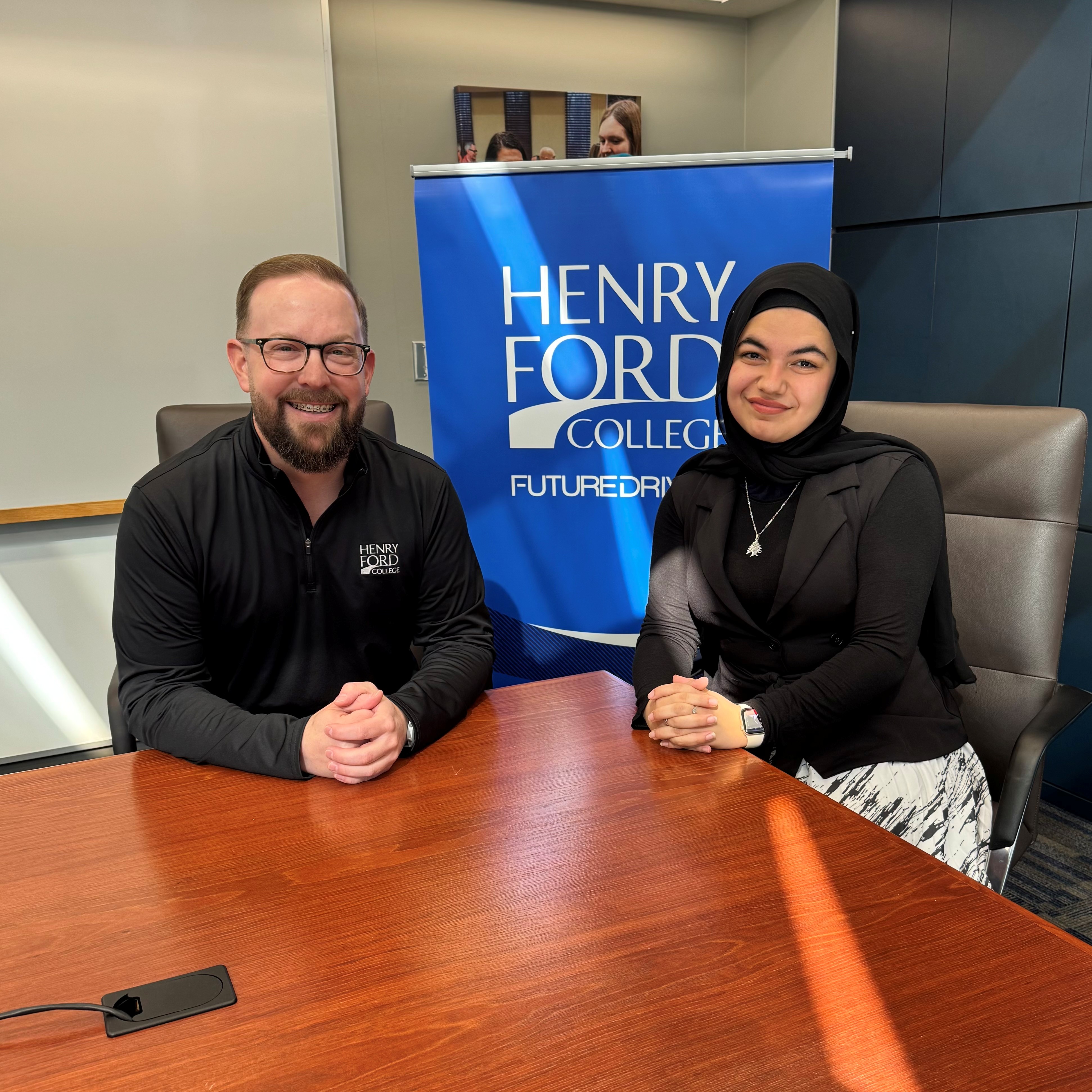
Henry Ford College President David Knezek, Jr. (left) and Mariam Dawi (right). Photo courtesy of Mariam Dawi.
Twenty-one years after attending Henry Ford College as a student, David M. Knezek, Jr. has returned to campus; this time as HFC’s seventh president.
Knezek began his tenure in 2026 after a career in public service that included serving as a Michigan state representative and senator, a Wayne County commissioner and, most recently, chief operating officer of the Michigan Department of Health and Human Services.
But during his first months at HFC, Knezek has focused on something that cannot be found on a résume: getting to know the people who make up the college community. “I can’t lead you if I don’t learn you,” Knezek said.
That philosophy has shaped how Knezek approaches his new role. Instead of spending all of his time behind a desk, he said he wants to be visible around campus, talking with students and employees and learning what they experience.
One of the things that has stood out most to him since returning to HFC is the commitment of its faculty and staff.
“People on the faculty and staff side truly care about this place,” Knezek said, pointing to employees who have spent years at HFC and remain committed to their students and the college.
He has also been struck by the resilience of HFC students. Knezek described students as approachable and engaged, recalling one student who called out, “Yo, Knezek,” while he was walking through the K Building. He said interactions like that help him feel connected to the campus.
He said students bring their own challenges into the classroom while continuing to demonstrate motivation and drive.
That has encouraged Knezek to stay visible and accessible. He follows what he calls the “10-foot rule”: if someone is within 10 feet of him, he engages with them. He said he will often walk students to a classroom, help connect them with an instructor or point them toward a campus resource.
For Knezek, connecting with students is not simply about being seen around campus. It is connected to his own experience as a student leader.
From student government to the president’s office
While he was a UM-Dearborn student, Knezek was involved in student government.
An adjunct faculty member encouraged him to start the Political Science Association. He later ran for senator in the School of Education and eventually became president of student government.
His time in student government allowed him to advocate for student concerns and showed him the impact students can have when they organize and speak up.
Among the projects he worked on were replacing blue books with green recycled books at the same or lower price, purchasing the rock that UM Dearborn students paint and advocating for the transition of the school’s mascot from “Wolves,” the school’s mascot from 1973 until 2013, to the Wolverines to unite all of UM’s campuses under the iconic maize and blue tradition.
Now that he sits on the other side of the administration, Knezek said he wants HFC students to continue using their voices.
“The best solutions don’t come from the top down,” he said. “The people who are best positioned to know what students want and need are the students themselves.” He plans to meet regularly with HFC’s student council and attend meetings when possible. He also encouraged students to invite him to meetings, workshops and other events.
Knezek acknowledged that students will not always receive the answer they want but said they deserve an explanation.
His own experience as a student leader also influences how he views student activism. He said a college cannot tell students to be active and outspoken and then become upset when they exercise their voices and rights.
A future for the Honors Program
Knezek said programs that are already doing well should be given opportunities to grow. He pointed to HFC’s Honors Program as one of the college’s successes and said its students and transfer outcomes are something HFC should be proud of.
He also praised Honors Director Chardin Claybourne and said he has enjoyed visiting the Honors Hub and speaking with students there.
“If Honors is doing great, how can we double it?” Knezek said, describing how he thinks about successful programs at HFC.
Knezek said he wants HFC to move away from describing itself as “just a community college.” Instead, he wants the college to recognize and communicate the quality of its programs, instructors and impact on students and the local economy.
He has also used the Honors Hub to introduce visitors to HFC and give them an opportunity to hear directly from students.
What are the plans for the Student Success Center?
One of the biggest questions facing HFC is the future of the planned multi-million-dollar Student Success Center.
Knezek said the project is currently paused while the college reassesses its scope, cost and potential impact on students, employees and HFC’s long-term fiscal health.
Rather than continuing with plans made before he arrived, Knezek said he wants to understand what students actually need from the project.
A major part of that process is looking at the student journey, from applying and completing orientation to enrollment, advising, counseling and other support services.
Ideally, he said, students should be able to access those services in a logical sequence without having to search around campus to figure out where to go.
Knezek said the college is currently assessing the project and expects to have a clearer picture in the coming months.
When asked about Honors students’ concerns about potentially losing or reducing space in the Honors Hub as a result of the project, his response was brief: “Message received.”
Building opportunities for students
While campus projects remain under review, Knezek said his first-year priorities center on relationships and opportunities for students. He wants to expand partnerships with employers, create more internship, co-op and paid work opportunities and strengthen connections that can lead students to full-time employment.
He also wants to expand HFC’s transfer relationships and articulation agreements beyond Southeast Michigan.
His goal is to create more opportunities for students to open doors after graduation, whether that means transferring to a four-year university or entering the workforce.
Knezek said he is particularly interested in using his professional network to help students find those opportunities.
He gave the example of an Honors student applying for internships in Lansing. After the student reached out to him, Knezek contacted two legislators and recommended her. Both ultimately offered her internships.
Getting to know David Knezek
Behind the presidential title, Knezek said family remains an important part of his life.
His parents live in Dearborn Heights, his sister in Allen Park and his brother lives in Brighton. He also enjoys spending time with his two nephews.
Outside of work, Knezek said he enjoys the outdoors and sports, including camping, rock climbing, white-water rafting and mountaineering. He also plays hockey, golf, pickleball and basketball.
He said maintaining that balance is important because constantly giving without taking time to recharge can eventually make a person less effective.
“If you’re constantly pouring out of your cup and you drain yourself down, you’re not effective anymore at that point,” Knezek said.
Twenty-one years ago, Knezek was walking the campus of HFC as a student. Today, he is walking through the same campus as the person responsible for leading it.
But if his first months as president are any indication, Knezek does not seem interested in leading HFC from a distance. He wants to know the students who call out to him in the hallways. He wants to hear from the student leaders who challenge his administration. He wants to visit the spaces where students learn, study and build their futures.
For Knezek, being president appears to mean more than occupying the president’s office. It means being part of the campus, one conversation, one hallway and one student at a time.