
A Modern Lesson in Censorship: Local Journalist Looks Back at the Forgotten History of Henry Ford
Gallery

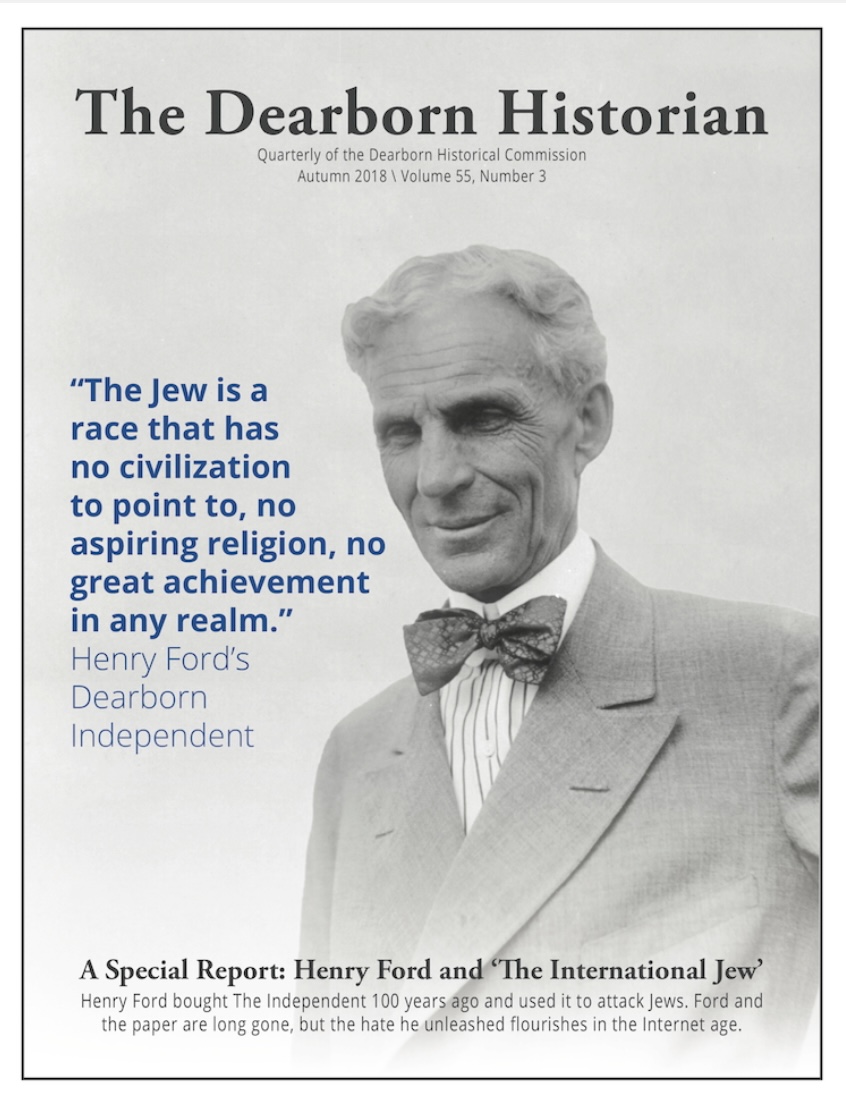
Cover of the Autumn 2018 edition of The Dearborn Historian (Volume 55, No. 3). Cover design by Lauren Davies
Henry Ford is a name we all know. The legendary American industrialist and business magnate founded the Ford Motor Company. He is credited as a pioneer in making automobiles affordable for middle-class Americans through the automated assembly-line system he created, now known as “Fordism.”
In 1918, Ford bought The Dearborn Independent, where he published a series of articles which were collected into a four-volume set titled “The International Jew: The World's Foremost Problem.” His articles mainly publicized his belief that the Jewish people played a large part in a multitude of issues, including financial panics, labor strikes, jazz music, modern movies, and global conflicts. Ford's publications reached international audiences and were translated into multiple languages.
Adolf Hitler would catch wind of Ford’s publications and even quoted them in his speeches. Hitler praised Ford in Mein Kampf, and a portrait of Ford was hung in Hitler's Munich office.
Local journalist Bill McGraw held an interest in the topic and published an article regarding the history of Henry Ford’s publications when he became editor of the Dearborn Historian. The result was not what he expected.
After working in the newspaper industry for over 40 years, McGraw retired from full-time reporting in 2017 but remained involved in part-time journalism-related jobs, such as writing for the Detroit Free Press and Bridge Michigan.
In 2018, McGraw was offered the job of editor of the Dearborn Historian. That year marked the 100th anniversary of Henry Ford buying the Dearborn Independent. That very fact inspired McGraw to write about the topic for the Dearborn Historian.
“I'm no expert in Henry Ford's relationship with Jews, or Hitler, or anybody. But I have read about it, and I also knew a key thing,” McGraw explained, “I just knew over the years talking to people that while most said Henry Ford was an anti-Semite, they didn't know the details.”
McGraw visited the Dearborn Public Library and was given access to the Henry Ford Collection, which essentially had every book or article published by or about Henry Ford, including publications related to the family, the company, etc. Upon doing his research, McGraw recalled what it was that Henry Ford believed about the Jews: “...it is one of the most common themes, which is that the Jews are controlling the world.”
Moreover, it was discovered that Henry Ford had published pieces speculating that the Jews controlled the international banking system, including the U.S. Federal Reserve. “Wall Street and Wall Street bankers" is kind of a code word for Jewish bankers. Henry Ford disliked such bankers because, while running one of the largest companies in the world during his time and making millions annually, he did not appreciate the treatment he received in the financial aspect of his business.
From a religious perspective, Jewish belief enabled the Jewish people to charge interest on loans to those who were not of Jewish belief. But this often contrasts with Islam and Christianity. For example, in medieval Europe, Christian and Islamic laws forbade their own followers from charging interest on loans (called usury).
McGraw said, “Ford didn’t have stock at the time as it was a private company. But he did have to deal with loans in order to expand his business.” At this point in his company's financial journey, he felt he was being “messed over” because of the methods used by the banking systems he became associated with. Pairing this with the knowledge of how the Jewish people were given the ability within their religious beliefs to give loans and charge interest, along with the common belief that the Jewish people controlled the banking system and therefore the world, Ford blamed the Jews.
McGraw explained that Ford believed the Jews had been behind the popularity of Jazz music as well. Ford was deeply nostalgic for the simple Anglo-Saxon agrarian past. Ford despised watching rapid modernization and urbanization completely changing the society he knew. Ford saw modern entertainment, such as jazz, movies, and even urban slang, as corrupting influences against wholesome American values. Ford believed that Jewish publishers and songwriters in places like New York’s Tin Pan Alley weaponized popular culture intentionally.
Once McGraw had completed his piece on Henry Ford’s publications, the issue of the Dearborn Historian was recalled. Jack Tate, who hired McGraw as editor, was and still is the head of the Dearborn Historical Museum, which is owned and operated by the City of Dearborn. The Dearborn Historian is the museum’s publication and is primarily distributed to local subscribers. Tate was obligated to share a draft of the Dearborn Historian with the Mayor of Dearborn, his boss, which featured Henry Ford on the cover with an anti-Semitic quote from Ford’s Dearborn Independent. Then-Mayor Jack O’Reilly told Tate to not release the publication. McGraw recalled that Tate “was talking about how he thought that they were going to have to kill this edition, this whole issue. They were not going to send it out to their subscribers of the libraries where it goes.”
McGraw had urged Tate to reconsider. He remembers saying, “Jack, if you do this, this is going to cause an uproar, because anytime a publication gets censored in the U.S., it's news,” McGraw warned, ”This is the type of thing where even the New York Times is going to do a story.” McGraw remembers that Tate laughed at that.
“Well, the New York Times did a story about it,” McGraw said, “I didn't tell the New York Times what was happening; they somehow picked up on it.” McGraw recollected what was in the works, what the mayor and the head of the museum were gonna do, “They were talking about killing the edition. So, what they didn't anticipate is that we had other ways of getting this story out.” McGraw was correct; the censorship resulted in a major uproar and drew national attention to the story.
McGraw was careful to explain, “Henry Ford had friendships with Jewish people. That's what's so contradictory about this whole thing. There was a famous rabbi in Detroit named Leo Franklin.” Franklin lived in the same Boston Edison neighborhood in Detroit as Ford before Ford built his mansion in Dearborn. Ford famously gave Franklin a new car every year as a symbol of their friendship. McGraw mentioned there was evidence pointing towards a break in the relationship between Ford and Franklin due to the Dearborn Independent publications.
McGraw credits his mother for his interest in journalism: “It actually started with my mother, who was a really voracious reader. She read all the bestsellers, and even beyond that, went to the library once a week. And when I was 18, and still in high school, she gave me a book about the New York Times, which was, believe it or not, a bestseller that year, 1969. It was titled, ‘The Power and the Kingdom.’ It is a really interesting book, and I read it cover to cover thinking, wow, I am really interested in reporting now. I didn't know at 18 what I wanted to be, and so that really started me down the path. And then in the early 70s, Detroit was a really turbulent place. The Detroit Police STRESS Unit killed a lot of young black men, and there were public hearings, of course. Coleman Young was running for mayor in 1973. He became Detroit's first black mayor. So all that stuff was going on, and I went to Wayne State, and I was living downtown by the university, and so I remained involved in what was happening by just watching. This series of events made me even more interested in current events.”
McGraw attended Wayne State University working toward a degree in history, beginning his college career in the fall of 1969 and completing his education in 2003. “My brother threw me a party,” he mentioned, “with the invitation saying ‘college, the best 35 years of his life.’” McGraw studied at Wayne State while working several newspaper jobs before becoming a full-time reporter for the Detroit Free Press. “I worked at Wayne State's paper, The South End, and some other local papers, so I got a lot of experience. And also, in that time, I went out to Denver and worked for a little more than a year at a thing called the College Press Service.”
As an experienced journalist, McGraw offered advice to student journalists, particularly with regard to dealing with misinformation. “You can't take information just willy-nilly off the internet or other platforms like Instagram. There is a way to verify stuff still today. You just have to be very diligent about not using anything unless you're really convinced that it's factual. You need to be very skeptical about all the information that's coming in. Being skeptical is not being cynical. That's a different thing, but you have to be really skeptical.”
McGraw is currently writing a book on Coleman A. Young, who was the mayor of Detroit for 20 years.