

Redefining Precision: Da Vinci Robotic Surgery System
Gallery
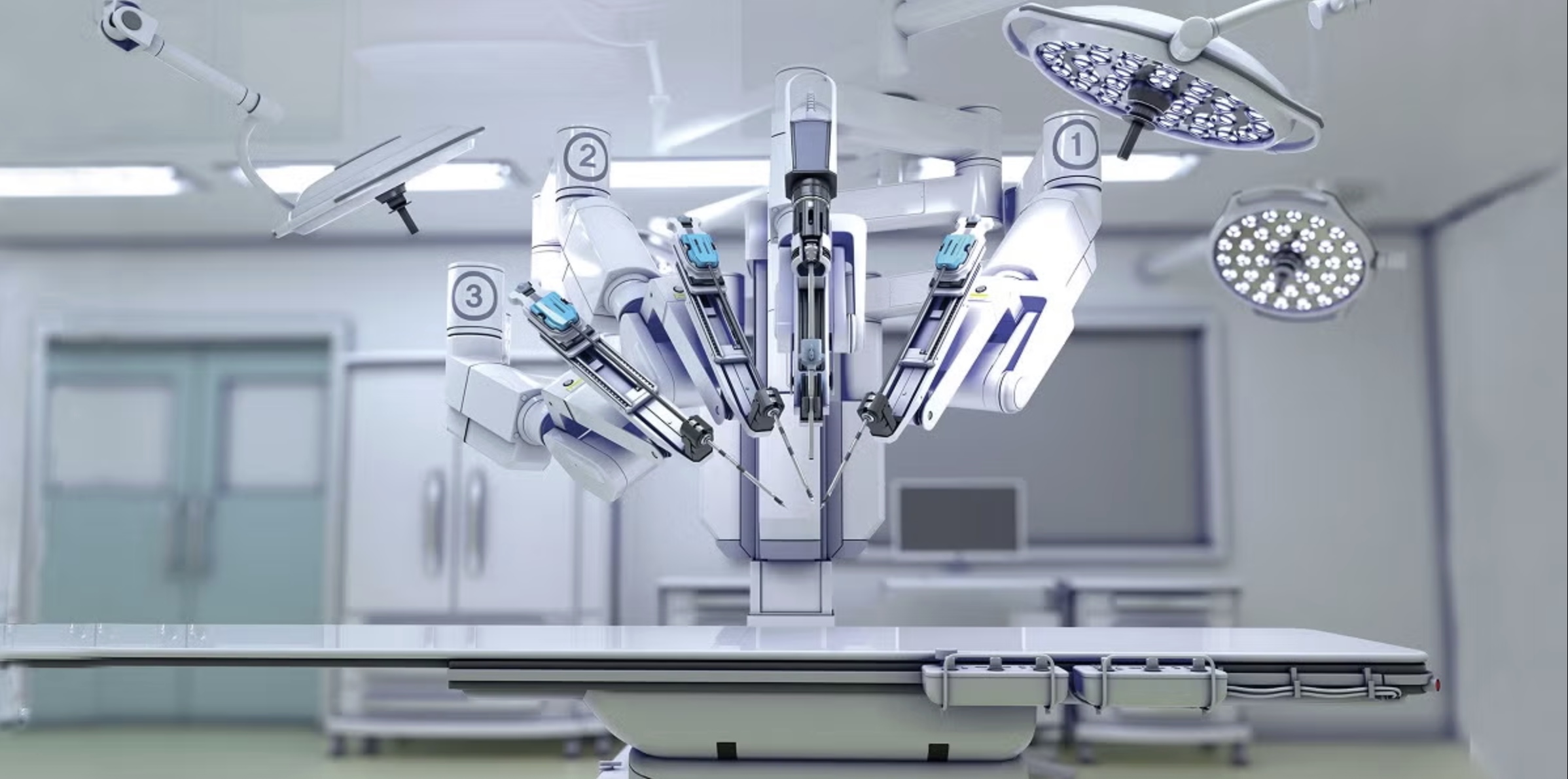
The Da Vinci Robot at Trinity Health Ann Arbor Hospital. Photo courtesy of Trinity Health
As technology advances, we have observed the myriad of immense evolutions in education and the workforce driven by Artificial Intelligence and technology in their broader context. During a recent visit to Trinity Health Hospital in Ann Arbor for my father’s injury, I couldn’t help but notice the numerous posters and flyers around the hospital regarding Trinity’s new robotic surgery technology.
Intuitive developed a world-class system for robotic-assisted surgery, introducing technology that allows surgeons to operate with micro-precision. As the Da Vinci surgical system has evolved through multiple versions, it has become an increasingly advanced tool. The system improves accuracy while enabling minimally invasive operations that result in less scarring.
This unique robotic system was named after Leonardo da Vinci for several reasons. Firstly, Da Vinci’s unparalleled 3D study of human anatomy inspired the system’s ability to provide in-depth, precise 3D visualizations to execute procedures. In addition to da Vinci’s precise 3D visualization of human anatomy, he is credited with inventing the first “robot” or automation recorded in mechanical engineering.
Finally, the system honors Da Vinci’s incomparable ability to master discipline and focus, as well as perfect his abilities in art, engineering, and science. The surgical robotic system mimics this by combining engineering and medicine, bringing unique visions to life and using them to advance the medical industry.
While using the robotic system to increase precision and reduce tremors and mistakes, the surgeons utilize their skills to operate from a console using 3DHD visualization software. These controllers translate hand movements into precise micro-movements of the automation’s instruments inside the patient. Because of its precision, the system enables smaller incisions, reducing tissue damage, speeding recovery and lowering the risks associated with surgery.
At Wayne State University, an MTRAC-funded project used computer-assisted technology to minimize bleeding during surgeries. According to a Wayne State article, “Intraoperative hemorrhage — colloquially known as ‘bleeding out’–is a leading cause of death in operating rooms around the world. It is estimated that at least 75% of this surgical complication is due to human or technical factors in anesthesia, blood transfusions, or the surgical procedure itself. Other causes may include structural anomalies, drug-related issues, or other health disorders.”
HFC student, Katie Lovette, shared her experience with robotic surgery. Lovette underwent gallbladder removal, “Initially, I was hesitant because [the doctor] informed me she wouldn’t be physically doing the surgery with her hands, but she would be operating a robot from a distance away. I had never heard of this before, so I was nervous. She assured me it was much more precise and they were having excellent results with using the robot!”
This system is used in over 10 million procedures, varying across different medical specialties. These specialties include urology, gynecology, general surgery, and head and neck surgeries. Urological surgeries that are performed by these unique automations include radical prostatectomy, nephrectomy, and cystectomy. In gynecology, operations include hysterectomy, myomectomy, and sacrocolpopexy. Head and neck surgery performed by the Da Vinci system includes Transoral Robotic Surgery. Finally, for general surgery, the operations include gallbladder removal, hernia repair, gastric sleeve, and colon resection.
According to Lovette, “I did have some intense soreness lingering in my ribs/chest area for a few weeks, and when I brought it up to my doctor, she said that the machine could have bumped one of my ribs. That was most likely causing the soreness, but there was no damage done. The surgery was definitely life-changing for me! I ended up in the ER several times leading up to my surgery due to pain and being unable to eat anything. I lost about 15 pounds in 3 weeks due to not being able to eat and was even having a hard time drinking water. I had to completely cut fat out of my diet, and I was essentially starving for a month leading up to my surgery. Immediately upon waking up from my surgery, I felt better. Within a week, I was eating normal foods again with no pain. My friends and I have joked that this surgery changed my personality in a way. It improved my quality of life so much, and I’m happy to say I haven’t had any serious complications!”
While the primary models of the Da Vinci system include Da Vinci X and Da Vinci Xi, the most advanced model is the Da Vinci 5. Da Vinci 5 features force-feedback technology. The Da Vinci SP (single port) system is designed for single-incision surgeries.
Although there remain limitations to the robotic surgery alternative, such as not being entirely suitable for all patients, being incredibly costly, and time-consuming, with each advancement, it is sure to become a more enhanced and common practice and become more convenient to a broader spectrum of patients.