

Dynamic Pricing, Scalping and Greed: How Ticketmaster Monopolized the Concert Industry
Gallery
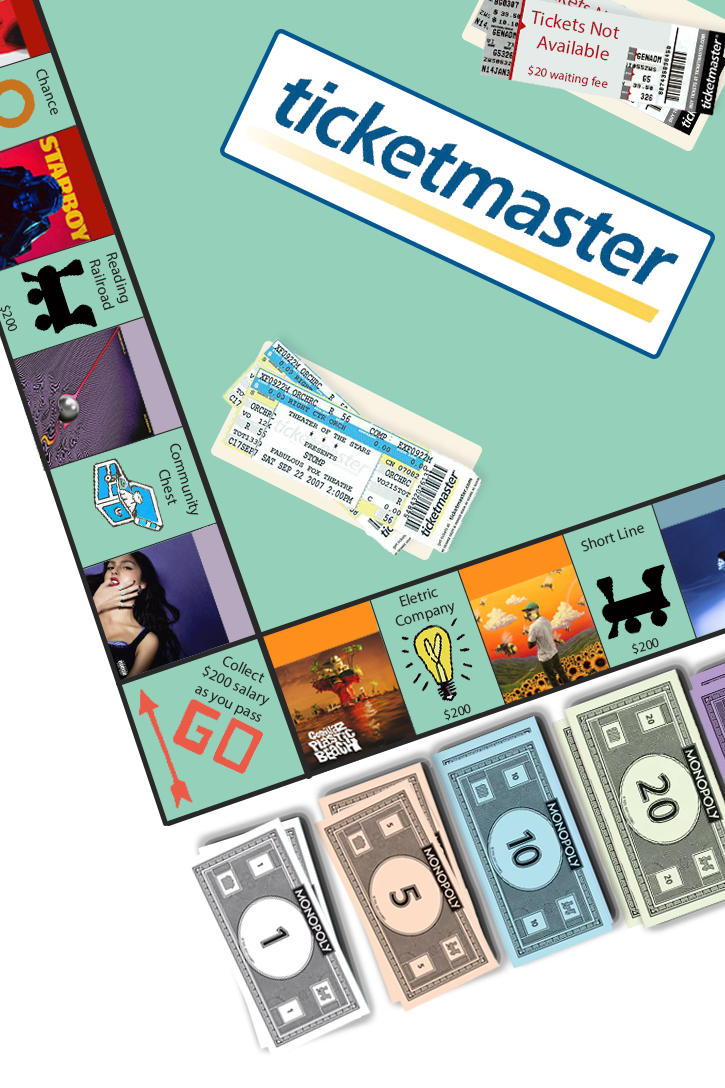
With the arrival of summer also comes the arrival of concert and festival season. This is the time when many artists, musicians, and bands start touring and performing around the world, and fans couldn’t be more excited. But as any fans know, actually getting the tickets for those events is by far the most tumultuous, frustrating and frantic part of the process. Staying up late refreshing web pages waiting for the sale to start, hoping the venue didn’t sellout in the pre-sale, frantically typing in your information, clicking around the stadium or theatre map hoping to find seats for you and your friends, trying to dodge the scalpers, seeing the price and hoping your not getting scammed.
With recent events like Taylor Swift's Eras Tour, tickets being scalped and resold at ridiculous prices put a spotlight on the ticketing industry and, in the case of the Swifties, leading to class action lawsuits against the company that has come to dominate the ticket-selling business, Ticketmaster.
Ticketmaster was created by university graduates Albert Leffler, Gordon Gunn and Peter Gawd. After seeing the rise in electronic ticketing that began happening in the 1960s, the trio decided to create Ticketmaster in 1976 after finding the necessary finances. Before Ticketmaster, the biggest computerized ticketing company was Ticketron, who made it easier for venues to set up their box offices and track their sales and profits. However, Ticketmaster quickly overtook Ticketron after Fred Rosen became the CEO in 1982. Rosen took a very aggressive approach to running Ticketmaster, essentially turning it from simply a ticketing system to an entire entertainment business.
In under ten years, Ticketmaster had bought out 4 smaller ticketing companies and eventually their main competitor Ticketron in 1991. According to Dorian Lynskey in “Who is behind the great rock’n’roll ripoff? How Ticketmaster swallowed the live entertainment scene,” published in The Guardian, “Ticketron billed clients to use its terminals, while charging fans a flat booking fee of $2.” Venues would also keep a portion of the tickets in their box offices and the rest of the inventory was given to Ticketmaster to sell, but, “He [Rosen] demanded exclusive deals with venues – 100% of the tickets available.”
According to Lynskey, Ticketmaster essentially bribed venues and promoters into exclusive deals with Ticketmaster, by providing upfront advanced payments, as well as “double surcharges and split the additional revenue with his clients, while offering generous signing bonuses and supplying the software and hardware for free.” This money made it easier for promoters and venues to plan and budget their concerts, which were becoming bigger and more elaborate, leading to them becoming dependent on the deals they have with Ticketmaster to produce their concerts.
Lynskey explains in his article, “Ticketmaster executive Alan Citron, Rosen promised that his company would become “the face of ticketing” and “take the bruises from people who don’t like the process.” They even help market and advertise and even offer to do the accounting. From a business perspective, these deals significantly increased profits, but the cost was passed on to the fans.
Ticketmaster demands all ticket sales be done through them, whereas before, tickets could be sold by the bands themselves and sold in box offices directly at the venue. Some musicians, who hated that their fans were paying more and more for tickets, and did not like that Ticketmaster was wanting control of all ticket sales.
The Grateful Dead ran their own ticketing company exclusive to them. As detailed in the book, “Ticket Masters: The Rise of the Concert Industry and how much the Public got Scalped,” authored by Dean Budnick and Josh Baron, Ticketmaster had turned down the band's proposed 50/50 split of their ticket inventory and instead demanded that they have 90%, which GDTS (Grateful Dead Ticketing Service) rejected. The two companies ultimately never made an agreement, but this did not persuade Ticketmaster away from continuing to demand control of all ticket sales with bands.
In 1992 the front man of the popular grudge rock bank Pearl Jam, Eddie Vedder, asked Ticketmaster to not raise the price of their tickets and keep the service fees affordable for their fans. At the time, an $18 Pearl Jam ticket had a service fee of about $1.80, but Ticketmaster wanted to charge a fee of $4 to $8 on that same ticket. Pearl Jam also wanted to stop hidden fees and have the specific service fees printed on the tickets. The band had tried to sell their tickets independently to make them more affordable for fans, but Ticketmaster threatened them with a lawsuit and shut down their ticketing machines. They even threatened other venues to not hire Pearl Jam or face a lawsuit.
Pearl Jam ended up canceling their 1994 tour, citing Ticketmaster as the main reason. The band just could not figure out how to operate and plan their tours without Ticketmaster’s involvement. The Department of Justice approached Pearl Jam for a congressional hearing over concerns of Ticketmaster. During this hearing one of the members of Congress asked the band, “Do you think Ticketmaster is entitled to a profit?” Guitarist, Stone Gossard, responded, “Are we entitled to use another company other than Tickermaster?” And the band's manager, Kelly Curtis, stated in his testimony that it would be almost impossible for someone to organize an event without Ticketmaster involvement, citing the exclusive contract that venues have with Ticketmaster as the reason. This hearing was the first time the company was officially described as a monopoly.
Ticketmaster defended themselves in the hearing by citing a study they had commissioned that claimed that of the 1.5 billion “live event” tickets sold per year, only 51 million were sold by Ticketmaster. However, this statistic is highly misleading as the study used a very wide definition of “live events” and included things like museums, amusement parks, and fairs. The company also argued that venues aren’t forced to work with Ticketmaster despite heavily incentivising them with upfront payments. Pearl Jam’s case against Ticketmaster was dropped in 1995, because despite having majority market share, there was not enough evidence that Ticketmaster used anticompetitive practices in order to constitute a monopoly.
Despite no legal action from it, the hearing put a huge dent in Ticketmaster's reputation and shined a light on their shifty business practices. As a result, the company ended direct “artist-to-fan” ticketing in 2002 making it impossible for musicians to sell their own tickets.
As the 2000s continued there were many people who had raised concern to the government about Ticketmaster being a monopoly. Ticketmaster owned “89% of the top fifty arenas, 88% of the top fifty amphitheatres, 70% of the top theaters and 75% of the top clubs,” according to “Ticket Masters – Part 3: The Ticketmaster’s Challenge: The Grateful Dead, Pearl Jam and String Cheese Incident” from Music Business Research.
In 2008, Ticketmaster decided to invest in artist management, supposedly to fix their reputation and relationships with artists after the Pearl Jam hearing. Ticketmaster once again changed who their customers were in order to secure market share. At the same time another company called Live Nation was quickly making a name for themselves as the top music promotion company in the United States. The company handled artist management and promotion but quickly diversified by buying up venues including the iconic “House of Blues” chain in 2006 and started their own ticketing services. This was supposedly another reason Ticketmaster invested in artist management, as a way to keep artists from working with anyone else. The two companies eventually merged into one giant corporation in 2010, with Live Nation becoming Live Nation Entertainment, becoming the parent company to Ticketmaster.
The U.S government put conditions on the merger in order to try to prevent a monopoly. One condition was Live Nation Entertainment could not retaliate against a venue for choosing not to work with them, and they could not force their clients to use their bundled services.
These conditions were swiftly ignored by Live Nation in 2013 when a venue chose AEG as their ticketing partner when MatchBox 20 was set to perform. Live Nation punished the venue by limiting who could perform there. Ticketmaster and its parent company, Live Nation Entertainment, continued to disregard the conditions of their merger by punishing venues and cornering artists into exclusively using their services.
The Ticketmaster and Live Nation merger instantly turned one company into a virtual monopoly, where the entire business of live entertainment, from artist management, to venues, to planning, to promoting, to operating, to ticket sales, to the resale market were all owned and operated by one corporation.
Since the merger, the vast majority of small venues are reporting smaller and smaller profit margins. Indie musicians playing at these venues complain about the exorbitant fees that their fans are paying.
To increase their profits even more, Ticketmaster introduced dynamic pricing, a pricing system that adjusts the price of the ticket in real time depending on the demand. The result is that the price drastically changes from the face value of the ticket. For example, in 2023, tickets for Bruce Springsteen, which were at face value $40 to $400 dollars, quickly skyrocketed to $4000 and upwards of $5000 dollars a ticket due to dynamic pricing. Kaitlyn Tiffany, reporting for Vox, wrote “Live Nation admits to helping artists scalp their own tickets to make more money,” in which Metallica's promoter admitted to working with Live Nation to scalp up to 88,000 tickets.
As a response to the backlash on scalping and fees, Ticketmaster and Live Nation started implementing “All in Pricing" where, if an event opts in, the entire price of the tickets including fees will be featured before check out.
But this did not stop resellers from being the largest and most glaring problem on the consumer front of Ticketmaster. The option to resell a ticket isn’t inherently bad, but Ticketmaster makes it ridiculously easy to resell in order to bloat prices.
A pre-sale doesn't make the situation any better. Scalpers will specifically look for shows with pre-sales, sign up for them, use bots to buy up a ton of tickets and instantly put them up for resale, leaving fans who didn’t know about the pre-sale to have to pay the inflated price.
Scalpers can also reverse engineer Ticketmaster tickets to resell them on other third party sites illegally. The most extreme example of ticket reselling was when tickets for Adel’s Las Vegas residency, which normally cost $80 went up to $40,000 per ticket.
Ticketmaster does have things like rotating barcodes on tickets and a verification feature to supposedly help address the bot issue, but this has barely reduced the scalping issue. Ticketmaster has no real incentive to stop scalpers because Ticketmaster benefits from the resell market through all the reselling fees that are paid on the ticket. In fact, Ticketmaster helps people scalp tickets. CBC reporters went undercover to a ticket scalping conference, where Ticketmaster was a featured speaker, and they found Ticketmaster works directly with ticket scalpers, or “ticket brokers” as they refer to them, to sell tickets for higher profits.
In 2019, a year before the merger between Ticketmaster and Live Nation was supposed to end, the federal government extended the merger for another 5 years. In 2022, the DOJ was about to start another investigation into Live Nation Entertainment, but around this time Live Nation Entertainment doubled their lobbying spending from the previous year. Despite its best lobbying efforts, though, nothing would prepare Ticketmaster for Taylor Swift’s Eras Tour.
In 2022, when tickets first went on sale for Taylor Swift’s massively anticipated Eras Tour, over 3.5 million people pre-registered for Ticketmaster's "Taylor Swift Eras Tour Verified Fan" program; however, the Ticketmaster site crashed and many people were left without tickets.
Trying to make her tickets more affordable for fans, Taylor Swift opted out of dynamic pricing, but this didn't stop resellers from inflating ticket prices. On top of this, people who had bought tickets through Ticketmaster were finding out that their tickets were being transferred out of their accounts without their knowledge. Tickets were being stolen. Ticketmaster responded by making it so that a ticket can’t be transferred until a few days before the event.
During the last stretch of Taylor Swift’s Eras Tour, the Vancouver show was selling “listening only” tickets for $15. These seats had no view of the stage and were meant to be for the fans who just wanted to be a part of this historic tour. But within the first hour, these tickets were bought up by scalpers who were reselling them for upwards of $3000.
Many fans decided to travel internationally to see the Eras Tour, since it was cheaper to buy a plane ticket and stay in another country than it was to see the show in the U.S.
Two days after the Eras Tour chaos, the Department of Justice wrote an open letter to the CEO of Ticketmaster, Michael Rapino, expressing the concerns they have about the company. This was followed with a lawsuit brought by the DOJ against Ticketmaster in 2024, with the goal of addressing the price gouging and ending the merger between Ticketmaster and Live Nation.
In addition, two class action lawsuits on behalf of Taylor Swift fans were filed against Ticketmaster. While one class action lawsuit is still pending, earlier this year, Live Nation settled the other lawsuit for $9.9 million to resolve allegations of misleading customers about ticket prices and charging deceptive fees.
On April 15, after a five week trial brought by attorneys general from 30 states, a federal jury in Manhattan declared Ticketmaster and their parent company Live Nation Entertainment guilty of running an illegal monopoly, “stifling competition and overcharging consumers.” Let's hope this verdict means the beginning of the end of the hold that Ticketmaster has over the concert industry so that fans can better afford to see their favorite artists.